
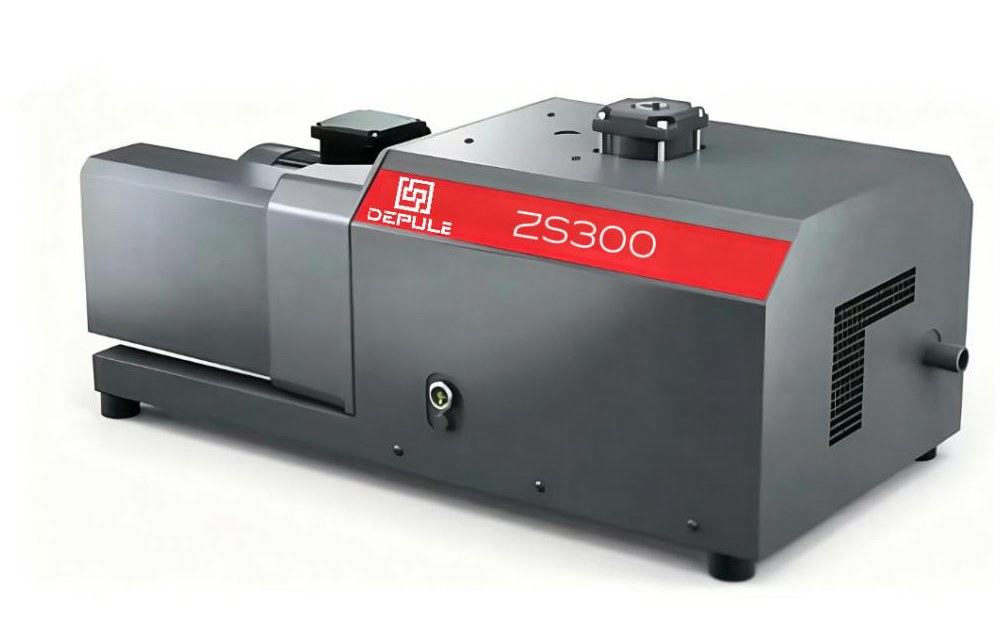
The difference between plastics duties is not the pump but whether the process needs flow or a steady pressure. Thermoforming needs a chamber evacuated quickly; extrusion calibration needs a vacuum that holds level for hours. The two are sized on different logic.
Thermoforming and vacuum forming
Sheet is heated and pulled onto the mould by differential pressure, so evacuation time sets the cycle. Work out total air demand from forming chamber volume times cycles per hour, then select at a working vacuum of 40 to 90 kPa.
- Small platen, single station: oil-free vane pumps V8 / V10 / V16, G3/8″ ports, oil-free exhaust, mounted next to the machine.
- Large platen, multiple stations: V25 / V40 or V25L / V40L (short body for mounting inside the machine guard), G3/4″ ports.
- Several lines on one vacuum source: a single-stage oil-sealed pump with a receiver, or a central vacuum system with a piped network.
On fast stations, line bore and valve response matter as much as nameplate capacity — an undersized line throws away effective pumping speed that a larger pump cannot recover.
Extrusion calibration and sizing sleeves
After extrusion the profile is held against the sizing sleeve by vacuum and needs a steady, pulse-free level.
Two things keep it steady: a receiver sized at roughly one fifth to one third of the pump’s hourly capacity to absorb peaks, and a lower set point inside the pump’s stable working band instead of running at the ultimate pressure. A single-stage oil-sealed pump (V0040A to V0100) with a buffer vessel is the usual arrangement.
Injection moulding venting and resin degassing
Venting the barrel and degassing epoxy or silicone draws gas carrying a little vapour. Oil-sealed models run with the gas ballast open and a filter on the inlet, so resin dust and condensables stay out of the pump chamber. Skip that step and the usual result is emulsified oil and falling capacity a few thousand hours later.
Vacuum handling and holding
Size on part weight, number of cups and cup area, then apply a leakage factor — rough surfaces, cartons and woven bags leak very differently. With several stations in parallel, check each branch bore; otherwise the first station to move takes the flow.
Woodworking, stone and glass holding stations are dusty, so an inlet filter is mandatory. Dust reaching the chamber is the fastest route to vane wear.
Configuration guidance
| Process | Inputs to confirm | Accessories |
|---|---|---|
| Thermoforming | Chamber volume, cycles per hour, working vacuum | Receiver, line bore, quick-release valve |
| Extrusion calibration | Number of sizing sleeves, allowed pressure band | Buffer vessel, fine filtration, pressure control |
| Injection venting / degassing | Type of volatiles, dust present | Gas ballast, inlet filter, oil mist separator |
| Vacuum handling | Part weight, cup count and area, surface | Filter, branch valves, gauge |
Send us these inputs and an engineer will calculate the pumping speed and list the accessories. Some models are not suitable for 60 Hz regions; for 60 Hz markets state country, voltage and frequency in the enquiry.