
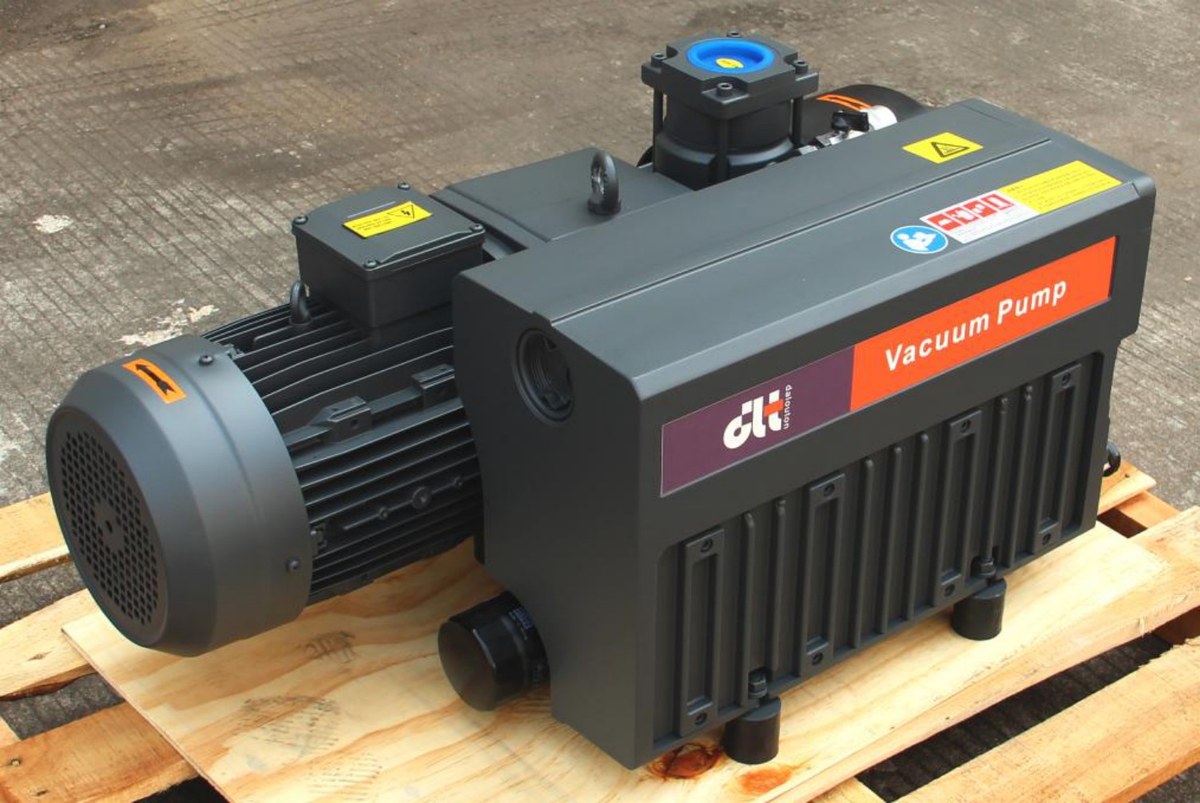
Coating, ion plating and sputtering lines usually run a diffusion or turbomolecular pump as the main pump, with a backing pump holding the main pump’s exhaust side at a workable pressure. Pick the backing pump badly and the main pump never reaches its rating, or oil migrates back into the chamber. For single-stage oil-sealed rotary vane pumps, the 0.1 mbar figure comes up constantly.
Two pressures, not one. Backing pressure sits at the main pump’s exhaust and is set directly by the backing pump. Chamber pressure is what the workpiece sees, set by both pumps together. A process calling for 5×10⁻³ mbar does not mean the backing pump must reach 5×10⁻³ mbar — it only has to stay under the maximum backing pressure the main pump allows, which the main pump maker states: typically 0.1–0.5 mbar for diffusion pumps and 1–10 mbar for turbopumps.
What single-stage pumps actually deliver.
| Model | Speed 50/60 Hz | Ultimate (ballast closed) | Ultimate (ballast open) | Power |
|---|---|---|---|---|
| V0025A | 20 / 26 m³/h | 0.5 mbar | — | 0.75 kW |
| V0040A | 40 / 48 m³/h | 0.1 mbar | 0.5 mbar | 1.5 kW |
| V0063 | 63 / 75 m³/h | 0.1 mbar | 0.5 mbar | 2.2 kW |
| V0100 | 100 / 110 m³/h | 0.1 mbar | 0.5 mbar | 3.0 kW |
From V0040A up, 0.1 mbar is reachable with the gas ballast closed, which covers diffusion pumps needing 0.1–0.5 mbar backing. V0025A reaches only 0.5 mbar and suits main pumps whose backing limit is above that.
When 0.1 mbar is not enough. Three cases: the main pump specifies a lower backing pressure (5×10⁻² mbar or below calls for a two-stage 2V80 at 4×10⁻⁴ mbar); the process outgasses heavily, so the backing pump must handle main-pump throughput plus outgassing and its speed runs out; or the pump sits near 0.1 mbar for long periods, where oil temperature and noise climb and a margin is wiser.
Measure it rather than guess: fit a gauge at the main pump’s exhaust, run a full process cycle, and read the peak backing pressure. If the peak exceeds 70% of the main pump’s limit, go up a size or add a Roots blower.
Preventing oil backstreaming. Fit an anti-suckback valve or use a pump with that structure built into the inlet; shut down in the order high-vacuum valve, backing pump, then vent; before long shutdowns, run the pump with the gas ballast open for a few minutes to clear condensable gas from the chamber.
What we need to size one. Gas type (corrosive, dusty), cycle (continuous or intermittent), an outgassing estimate, the main pump’s backing limit, and the available supply. With those, model and port size can be fixed.