
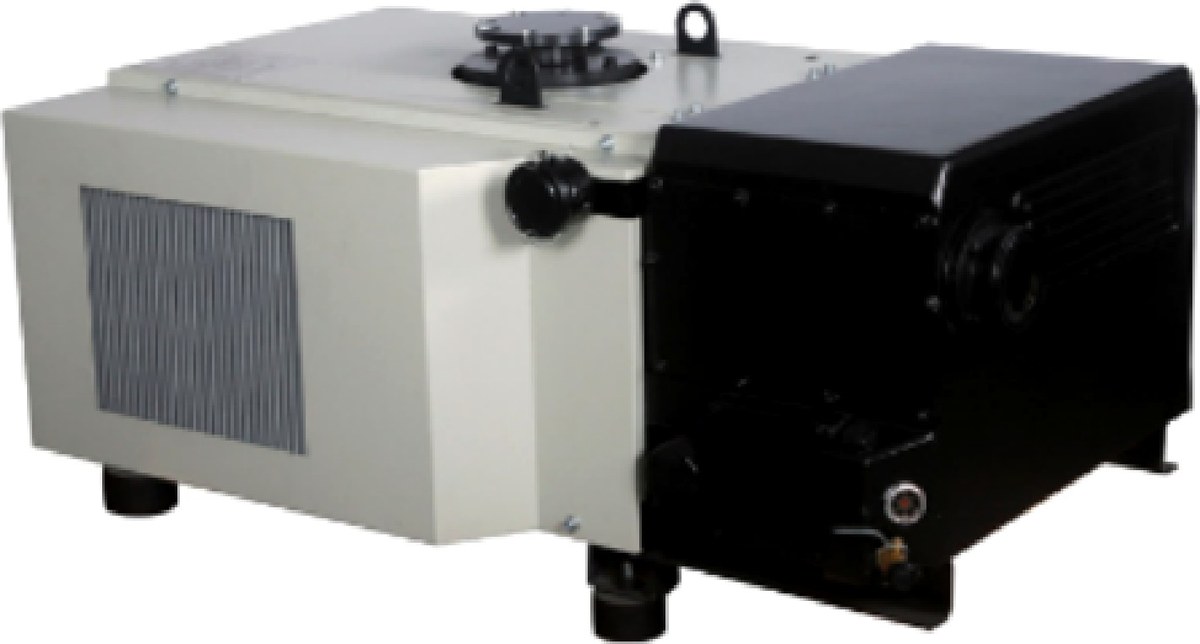
The usual question from the floor is whether another brand can be poured in when the oil is low. Three separate problems hide in it: whether to top up, whether the mixed oil can stay, and whether the residual old oil must be flushed. They have different answers, and treating them as one usually costs oil without restoring vacuum.
1. Top up or change
| Case | Top up? | Action | Watch for |
|---|---|---|---|
| Same brand and grade, low level only | Yes | Top up to the sight-glass centre, record the amount | Re-check ultimate pressure within a week |
| Different brand, same grade, emergency | Small amount | Take it above the low mark, run to the next planned stop, then full change plus one flush | Sight glass for 24 h |
| Mineral oil meeting synthetic (PAO, ester) | No | Full change, two flushes, record both brands | Re-check in a week; one grade drop means change again |
| Oil whitened, solvent smell, level risen by itself | No | Find the water or solvent source, then full change | Shorten the interval |
The line sits at the oil family. Within one family and grade an emergency top-up does no harm if recorded; across families do not mix, because the problem is not viscosity but additive packages.
2. Why mixing causes trouble
ASTM D7155 makes compatibility measurable: blend the two oils 50:50, 10:90 and 90:10, hold at 65 °C for 168 hours and inspect for haze, precipitate and separation. Incompatible mixtures commonly form a precipitate that plugs filters and oil passages — Tier 1, visual. Deeper tiers run D1401 demulsibility, D892 foaming, D445 viscosity and D664 acid number.
On an oil-sealed vane pump, demulsibility fails before precipitate shows. In wet duty the oil must shed water inside the tank; once additive systems are mixed, that ability follows the poorer of the two, the oil stays milky, the film stops sealing and pumping speed falls while level and colour still look normal.
3. Sum one: how many changes clean the sump
With r the residual share of a fill, the old-oil share after n changes is r to the power n (ideal fully mixed; reality runs a little lower).
| n | r = 10% | r = 20% |
|---|---|---|
| 1 | 10% | 20% |
| 2 | 1% | 4% |
| 3 | 0.1% | 0.8% |
Small sumps sit near 10%: a V0100 (2 L fill) leaves 0.2 L, then 0.02 L, then 0.002 L, using 6 L over three changes. Large sumps run nearer 20%: a V0630B (20 L fill) leaves 4 L, then 0.8 L, then 0.16 L, using 60 L.
Two flushes after mixing bring the share under 1% (or 4%), below the residual of a normal change. On the large pump a third flush spends another 20 L to move 0.8 of a point, so two is enough; small pumps can take three.
4. Sum two: marginal cost of flushing
A V0630B at 6000 h a year on a 2000 h interval gets three changes: 60 L straight, or 3 × 3 × 20 = 180 L with two flushes each time, plus one to two hours of downtime per change. The same money on inlet filtration, ballast use and a cold trap keeps water and dust out of the chamber earlier in the chain. Small pumps read differently: 0.75 L in a V0025A, 1.5 L in a V0040A, so flushes are cheap. Fill volume and downtime decide the count.
5. Seven steps for an oil change
- Run 30 minutes so the oil warms, thins and drains.
- Stop, isolate, tag out, open the filler plug to release tank pressure.
- Drain into a tray rated at 1.5 times the fill volume.
- Refit the drain plug, run 10–20 seconds with the inlet open while adding a little fresh oil through the inlet; repeat while drainings stay dirty.
- Refit the plug (renew an aged seal) and fill to the sight-glass centre with the pump stopped.
- Jog twice for noise or oil carry-over, then run on; in wet duty open the gas ballast 20–40 minutes and close it.
- Record date, hours, oil brand and grade, fill volume, ultimate pressure re-measured.
Step 4 is skipped most often and matters most: without it, fresh oil sits on old oil and lifts r from 10% to 30% or more.
6. Oil log and fill volumes
Four columns: running hours, oil brand and grade, fill volume, ultimate pressure with ballast closed — plus a note on whether and how many times the pump was flushed.
| Model | Fill | Model | Fill |
|---|---|---|---|
| V0025A | 0.75 L | V0155 | 4 L |
| V0040A | 1.5 L | V0160 / V0202 | 6 L |
| V0063 / V0100 | 2 L | V0302 | 8 L |
| 2V18 | 0.75–1.05 L | V300B | 8.5 / 11.5 L |
| 2V28 | 1.2–1.5 L | V0630B | 20 / 23 L |
| 2V80 | 5 L | 2V275 | 18 L |
The larger the fill, the more a mixed charge costs. Speeds and connections are on the V0025A–V0100, V0155, V0630B and 2V80/2V275 pages. Interval setting and spent-oil signals are in oil change intervals and three sources of oil emulsification; the calculator gives pump-down times.
For 60 Hz regions, confirm the motor and oil configuration with the factory before ordering — the specification sheet notes that some models are not suited to 60 Hz regions — and recalculate the interval rather than reusing 50 Hz figures.
Related reading
- Is 0.1 mbar enough for a coating backing pump
- How to Choose Vacuum Pump Oil and When Oils Can Be Mixed
- When to open the gas ballast valve, and for how long
- V0025A-V0100 single-stage oil-sealed vane pumps
- V0155 single-stage oil-sealed vane pump 150 m³/h
- DPL-V630B Oil-Lubricated Single-Stage Rotary Vane Pump