
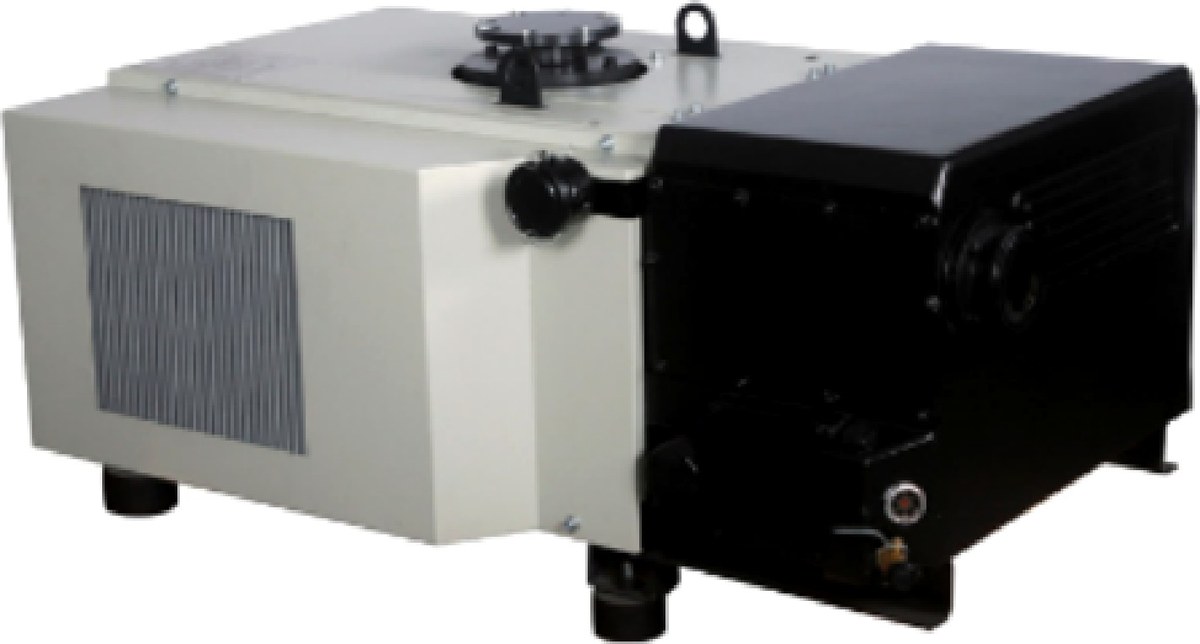
Oil in an oil-sealed rotary vane pump is not only a lubricant. It forms the film between the vanes and the cylinder that closes the leakage path, which is what allows the pump to reach the 0.1 mbar range; it also carries away compression heat and flushes wear particles and dust down to the oil sump. Choose the wrong oil and the symptom is not “slightly faster wear” — it is a pump-down time that stretches and an oil change interval that halves. This article separates the two questions: how to choose, and whether oils can be mixed.
1. Pick the oil family by vacuum level, then the viscosity grade by duty
ISO 6743 groups oils for oil-lubricated positive-displacement pumps in family D, split by working vacuum into low, medium and high vacuum ranges, each with a non-corrosive and a corrosive-gas variant (DVA/DVB, DVC/DVD, DVE/DVF). DIN 51506 classifies by additive content and load instead: VB and VC are additive-free mineral oils, VBL and VCL carry oxidation inhibitors, VDL is for high-pressure heavy duty. Both systems point the same way: the deeper the vacuum and the heavier the load, the more oxidation resistance and the lower the vapour pressure required.
Our single-stage oil-sealed vane pumps from V0025A to V0100 (V0025A–V0100 product page) reach 0.1 mbar ultimate pressure with gas ballast closed, and 0.5 mbar for the V0025A. That sits at the boundary between low and medium vacuum, so a mineral vacuum pump oil with oxidation inhibitors is the right family; a high-vacuum diffusion pump oil is thinner and gives a weaker film in this kind of pump.
Viscosity grade depends on four things: rotational speed, oil temperature, clearance, and inlet temperature. Higher speed takes one grade lower — most of our 50 Hz models run at 2900 r/min, the V300B at 1500 r/min, so the larger pump can take one grade higher at the same duty. Persistently hot oil (poor cooling air, continuous running) takes one grade higher. Frequent cold starts in winter with tight clearances argue against thick oil: it starves the oil pick-up and raises starting current.
For 60 Hz markets, confirm with the factory before ordering: the datasheet notes that some models are not suitable for 60 Hz areas, and the higher speed changes oil temperature and oil requirements.
2. Worked example: how oil condition turns into pump-down time
Use this for the roughing stage:
t = (V / S) × ln(P0 / P1)
V is chamber volume in m³, S is effective pumping speed in m³/h, and t comes out in seconds when multiplied by 3600.
Take a V0100 with 100 m³/h nominal speed, pumping a 2 m³ chamber from 1000 mbar down to 10 mbar. First the effective speed: allow 70% of nominal after piping, valve and filter losses, so S = 70 m³/h = 70 ÷ 3600 = 0.0194 m³/s.
t = (2 ÷ 70) × 3600 × ln(1000 ÷ 10) = 102.9 s × 4.605 = 474 s, about 7 min 54 s.
Now the same pump with degraded oil — too thick for cold starting, or emulsified so the film no longer seals — and effective speed falls to 50 m³/h:
t = (2 ÷ 50) × 3600 × 4.605 = 144 s × 4.605 = 663 s, about 11 min 3 s.
Same pump, same chamber, 40% more time. On a production line that is a cycle-time problem, not a feeling.
Near ultimate pressure use the corrected form t = (V / S) × ln[(P0 − Pu) / (P1 − Pu)], with Pu = 0.1 mbar for a closed gas ballast. Substituting: ln(999.9 ÷ 9.9) = 4.615, so t = 102.9 s × 4.615 = 475 s — one second more than before. At the 10 mbar level the limit is effective pumping speed, not ultimate pressure; oil problems show up in speed first and in ultimate pressure later. The pump-down calculator does the same arithmetic on site.
3. Oil charge and change interval: count the litres per year first
| Model | Oil charge |
|---|---|
| V0025A | 0.75 L |
| V0040A | 1.5 L |
| V0063 / V0100 | 2 L |
| V0155 | 4 L |
| V0160 ~ V0302 | 5 ~ 8.5 L |
| V300B | 8.5 / 11.5 L |
| V0630B | 20 / 23 L |
Five V0100 pumps, 2 L each, 4000 running hours a year:
- 500 h interval: 8 changes, 16 L per pump per year, 80 L for five pumps;
- 1000 h: 4 changes, 8 L per pump, 40 L total;
- 2000 h: 2 changes, 4 L per pump, 20 L total.
A wrong oil that shortens the interval from 2000 h to 500 h takes annual consumption from 20 L to 80 L. The price difference between oils is far smaller than that ratio, so the cheaper oil is usually the more expensive one. Clean dry duty (electronics, packaging, pick-and-place) at 2000 h is reasonable; humid duty (cooking, drying, after washing) needs a shorter interval.
4. Mixing oils: four cases
- Same brand, same grade, top-up: fine, fill to the centre of the sight glass.
- Same viscosity grade, different brands: not for long-term running. Base oil refining depth and additive packages (oxidation, demulsibility, antifoam) differ; the blend may turn cloudy or drop sediment, and the loss of demulsibility matters most — an oil-sealed pump relies on it to separate water quickly, and once it degrades the oil stays milky.
- Mineral with synthetic (PAO, ester): do not mix. Polarity differences can separate the blend, additives consume each other, and the result is a normal oil level with poor vacuum.
- Emergency: a small top-up of another oil to keep above the low mark until the next planned stop is acceptable; then drain completely and record brand and grade for the next investigation.
After any mixing: run with gas ballast for 20–30 minutes to drive off moisture, watch the sight glass for 24 hours for cloudiness or separation, and re-check ultimate pressure with gas ballast closed after a week. If it is one step worse than with fresh oil (for example 0.1 mbar to 0.3 mbar), drain the whole charge instead of topping up.
5. Selection check list
| Duty | Oil direction | Watch for |
|---|---|---|
| Clean dry gas, intermittent | Mineral vacuum oil with oxidation inhibitors | 2000 h or six months, judge by colour and viscosity |
| Moisture (cooking, drying, after washing) | Oil with defined demulsibility | Run gas ballast, shorten interval, change when milky |
| Solvent (printing, coating, degreasing) | Oil compatible with the solvent | Falling viscosity and flash point, ventilate |
| Dust | Standard oil plus effective inlet filtration | Dust attacks the vanes first; oil is the symptom |
| Corrosive gas | Select per DVB/DVD/DVF class | Confirm materials and oil with the factory |
Stating gas composition and duty cycle at the selection stage costs less than changing oil later. From the V0155 (V0155 product page) upward and on the V0630B (V0630B product page) the oil charge is large and one change is expensive, so getting the oil right at the start matters more.