
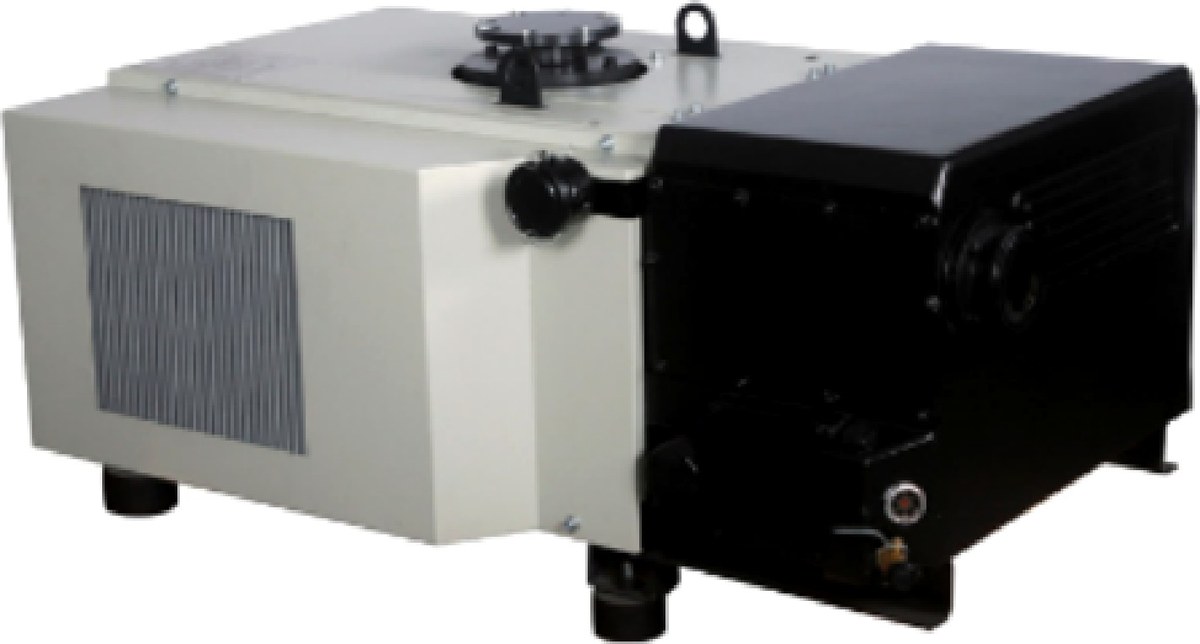
Milky oil is not a bad batch of oil — it is water in the oil. Pumping condensable vapour at a high compression ratio lets vapour condense in the chamber and oil case, and the oil turns cloudy. Opening the gas ballast admits a small amount of air before compression, drops the partial pressure of the vapour below its saturated vapour pressure, and carries it out as gas.
The cost is ultimate pressure. On a V0630B the figure moves from 0.1 mbar with the ballast closed to 0.8 mbar on the single setting and 2 mbar on the double setting. That shift is not a fault — with air admitted, the achievable pressure rises.
What each setting is for
| Ballast | Duty | V0630B ultimate pressure |
|---|---|---|
| Closed | Clean, dry gas where a low ultimate pressure matters | 0.1 mbar |
| Single | Light condensable load, gas with some humidity | 0.8 mbar |
| Double | Heavy moisture load, or a process already running at higher working pressure | 2 mbar |
The same trade applies across the range: on the V0040A to V0100 single-stage models it is 0.1 mbar closed against 0.5 mbar open, and on the 2V80 two-stage it is 4×10⁻⁴ mbar against 5×10⁻³ mbar. For clean dry gas keep the ballast closed; there is nothing to gain by giving up vacuum.
When to open and close
Trigger on process stage, not on the clock. Open through the wet part of the cycle, close for the deep vacuum step:
- Wet phase — early heating of the load, right after the chamber is vented, solvent evaporation: ballast open, so the vapour leaves with the gas stream.
- Deep phase — pulling down to working pressure: ballast closed, to reach the designed ultimate value.
- Continuously wet process: keep the single setting open and trade a little ultimate pressure for oil life, rather than changing oil often.
Where the whole process is wet and a low ultimate pressure is still required, the ballast alone is not enough. Fit a cold trap or a pre-condenser ahead of the pump so most of the vapour is taken out before it reaches the chamber.
What to watch in service
- Milky or foaming oil in the sight glass: the inlet carries more water than the current setting handles — move up a setting or extend the open period.
- Shorter oil change intervals with more sludge: check whether the pump has been running with the ballast closed on wet gas.
- Ultimate pressure short of the rated figure: confirm the ballast is fully closed before looking at seals and leak rate.
Valve travel and detents differ between models — check the manual for the unit in hand before adjusting. Parameters follow the specification sheet; configurations vary by batch, so confirm with the factory before ordering.
Need a model matched to your duty?
Send the process, target pressure, gas composition and running pattern, and we will propose a model and the accessory list.