
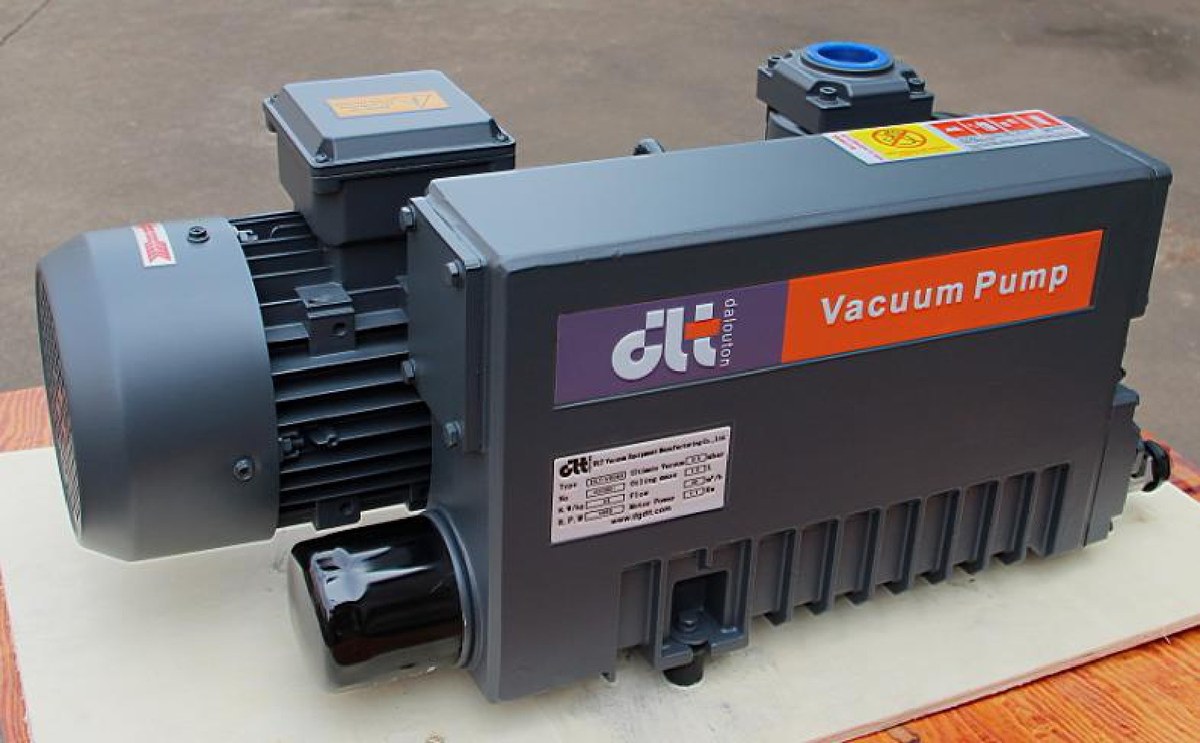
Vane wear is the classic slow failure of a rotary vane pump. It does not announce itself with a bang; for weeks or months it shows up as a pumping speed that sags a little and an ultimate pressure that creeps upward. The vanes are the only parts that slide continuously against the chamber wall — oil-sealed pumps rely on an oil film, oil-free pumps on graphite or carbon-graphite self-lubrication — and in neither case does the worn material grow back. The usual problem on site is that the pump is only inspected after a workpiece will not hold or a chamber will not reach process pressure, by which time the wear has often spread from the vanes to the chamber bore and a vane job has become a pump job.
The checks below run from “no disassembly” to “open the pump”, and every one of them fits into a pre-shift walk-around.
1. Why vane wear eats pumping speed first and ultimate pressure second
The vanes are thrown out of the rotor slots by centrifugal force (some designs add springs) and pressed against the chamber wall, dividing the crescent-shaped working space into a suction side and a compression side. Wear happens in two places: the contact band at the tip widens, and the vane gets radially shorter. Both mean the same thing — the clearance between tip and wall grows, and gas from the compression side leaks back into the suction side.
The consequences arrive in order:
- Ultimate pressure degrades first. A single-stage pump’s ultimate pressure is limited by its compression ratio, and leakage across the clearance caps that ratio. DPL-V0025A reaches 0.5 mbar with the ballast closed; DPL-V0100 reaches 0.1 mbar. Both are single-stage oil-sealed designs, and the 0.1 mbar class is the more sensitive of the two — it moves first.
- Pumping speed follows. Volumetric efficiency drops, the rated 100 m³/h is no longer delivered, and the loss grows as the gap grows.
- Oil temperature and noise rise. Leaked-back gas is compressed again and again, doing work and making heat; the vane rattles in its slot and starts to knock.
2. Five signals you can measure without opening the pump
| Signal | How to measure | What counts as abnormal |
|---|---|---|
| Ultimate pressure, blanked off | Close the inlet valve, run 15–20 min, gauge directly at the pump inlet | An order of magnitude off the rating (a 0.1 mbar pump stalling at 1 mbar) |
| Pump-down time on a fixed duty | Log seconds from atmosphere to target pressure on the same chamber | 15 % slower than baseline means investigate; 25 % means open the pump |
| Debris in the oil | Catch a cup of old oil at change and let it settle | Silver flakes (cast iron vanes) or fine black particles (carbon vanes) |
| Running noise | Listen at steady speed, or use a metal rod against the housing as a stethoscope | Even hum turning into intermittent tapping; metallic scraping means stop immediately |
| Oil level and current | Weekly log of level and running current | Level falling faster than usual (oil carried into the inlet side); current 5–10 % below rated |
The third is the earliest signal and the easiest to miss — most people drain the old oil without ever looking at it. On the fourth, distinguish the source: bearing noise sits toward the end cover, while vane rattle comes from the lower middle of the housing and follows the shaft speed.
3. Worked example: 20 % speed loss costs 25 % of throughput
Pump-down time is estimated as t = (V / S) × ln(P0 / P1), with V the chamber volume, S the effective pumping speed (in the same volume unit per time), and P0, P1 the start and end pressures. Take DPL-V0100 (100 m³/h at 50 Hz, 3.0 kW, ultimate pressure 0.1 mbar with ballast closed) on a 1 m³ chamber from 1013 mbar down to 1 mbar:
- New vanes: S = 100 m³/h, so V/S = 1/100 h = 36 s, and t = 36 × ln(1013) = 36 × 6.92 ≈ 249 s
- Effective speed down to 80 m³/h (20 % lost to clearance leakage): V/S = 45 s, so t = 45 × 6.92 ≈ 311 s
That is 62 s per cycle. The throughput loss is not 20 % but 25 %, because time is inversely proportional to speed: 1 ÷ 0.8 = 1.25. At 200 cycles a day, it adds up to 3.4 hours. The same arithmetic explains why “it feels a bit slower” on the floor usually means more than ten percent: nobody notices fifteen seconds, everybody notices two or three extra hours a day.
4. Confirming it on the bench: measure three things
Once leaks, oil condition and the gas ballast valve are ruled out, open the pump and check:
- Vane thickness and length against the spare-parts drawing. The common workshop criterion is roughly 1 mm of radial wear, or any chipped corner or through-crack — that is the red line, not a life prediction.
- The chamber bore. Run a finger and look under a light: deep grooves, scoring or a visible change in roundness mean the clearance has already chewed the wall. Replacing vanes alone will not fix that; the chamber or the pump has to go.
- The rotor slots. Carbon build-up and burrs stop the vane from extending fully and show up as uneven wear on one side.
Replace the whole set, never just the worst vane. A few tenths of a millimetre of height difference means the new vane is pressed harder and carries more load, which accelerates wear on the remaining old vanes and on the bore. The V0025A–V0100 range uses a fixed vane count per rotor, so ordering by set is simpler anyway.
5. Setting the replacement point so it does not surprise you
Hour-based planning is only a reference: manufacturers typically quote 10000–20000 hours for carbon-graphite vanes in oil-free pumps, and oil-sealed designs, where the oil film helps seal, run longer between overhauls. Both numbers scatter widely with duty — dusty gas, continuous 24-hour high-temperature running and frequent starts all push real life down.
The reliable approach is two-track: stock by hours, replace by measurement. Log ultimate pressure (blanked off) and pump-down time on a fixed duty every week; when both curves drift downward together, the clearance is opening up. When either exceeds baseline by 25 %, schedule a shutdown window. Spares then arrive a month ahead instead of being ordered after the line has stopped.
Note that worn vanes rarely travel alone: a loaded mist separator raises crankcase pressure and disturbs the oil level, and a torn inlet filter sends dust straight into the chamber to grind faster. Deal with those first — inlet filtration and dusty duty works through the pressure-drop-to-speed conversion, and oil emulsification explains how water in the oil drags the vanes down. Change oil, mist separator element, inlet filter and end-cover seals in the same visit rather than opening the pump twice. DPL-V0100 holds 2 L of oil and DPL-V0025A holds 0.75 L, while the DPL-V25 oil-free model has no oil circuit at all and concentrates maintenance on vanes and inlet filtration.
6. When not to open the pump
- Poor pressure under load but normal when blanked off: look for system leaks, piping and flange seals, not vanes.
- Speed down across the board with normal oil level and unchanged ultimate pressure: check a blocked inlet filter and piping conductance.
- Ultimate pressure poor and the oil milky: condensable vapour has entered the oil; fix gas ballast and upstream condensation first.
- Gas ballast valve not fully closed: it is an open leak on the inlet side and mimics vane wear closely.
Part of this can be avoided at the selection stage: the pump-down time calculator gives the time for a given chamber and target pressure, which then becomes your baseline. Settle the six duty items — target vacuum, chamber volume, gas composition, continuous or intermittent operation, connection size and voltage/frequency, and delivery location — before fixing the model; the FAQ covers the matching entries. For 60 Hz regions, note that some models are not suited to 60 Hz supplies and the motor and speed configuration must be confirmed with the factory before ordering.