
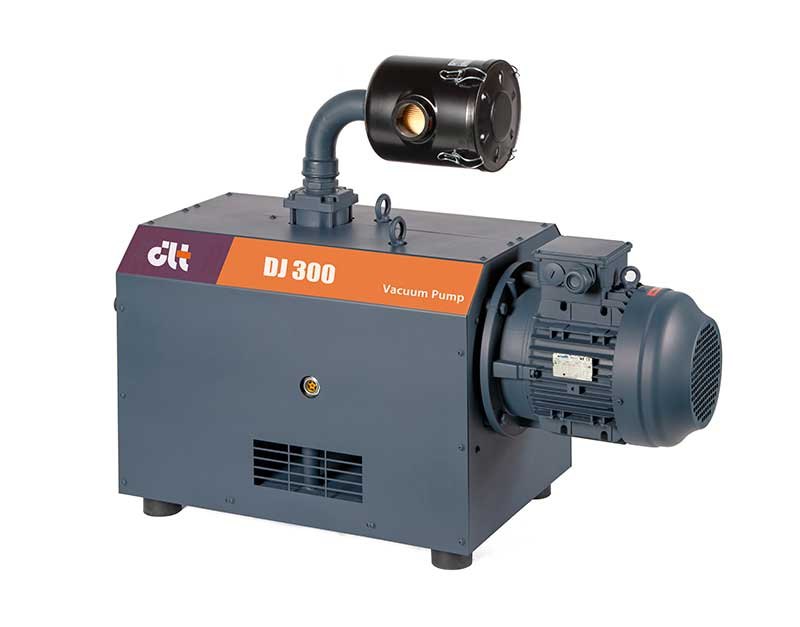
200–700 m³/h, or 55.6–194 L/s, is the band most often compared on price: furnace roughing, coating line backing, chemical distillation, freeze drying and the main pump position in central vacuum systems. What goes wrong here is rarely the pump. Two details account for most of it: the inlet is sized one step too small and the piping eats half the pumping speed, or the motor is upsized “for safety” and the extra money buys no pump-down time. The figures below come from the published data for V0202, V0302, V300B and V630B.
1. Where the four models actually differ
| Model | Rated speed at 50 Hz | In L/s | Ultimate (ballast closed) | Motor | Inlet | Weight |
|---|---|---|---|---|---|---|
| V0202 | 200 m³/h (240 at 60 Hz) | 55.6 | 0.1 mbar | 5.5 kW | G2″ / G2″ | 140 kg |
| V0302 | 300 m³/h (360 at 60 Hz) | 83.3 | 0.5 mbar | 7.5 kW | G2″ / G2″ | 190 kg |
| DPL-V300B | 280 nominal / 240 actual | 66.7 | ≤8×10⁻² mbar | 5.5 kW | G2″ flange | 223 kg |
| DPL-V630B | 700 nominal / 640 actual | 177.8 | ≤8×10⁻² mbar | 15 kW | DN100 / DN160 | 730 kg |
Two differences are easy to miss. V0202 and V0302 are quoted with one rated figure, while V300B and V630B carry both nominal and actual values; nominal is for price comparison, actual is for pump-down time, and on V630B the gap is 8.6% (700 against 640). And V300B shares 5.5 kW with V0250 for only 10 m³/h more speed, yet reaches ≤8×10⁻² mbar against 0.5 mbar — that difference is the ballast valve and stage geometry, and it is why V300B is the right step when you need below 0.1 mbar without going two-stage. Full data: V0160–V0302 single-stage oil-sealed pumps, DPL-V300B, DPL-V630B.
2. Sizing the inlet: calculate the velocity first
The pump flange is a connection minimum, not a statement that the size can carry that flow. Velocity follows from continuity:
v = Q / A, with Q the actual pumping speed and A the pipe cross-section
For the four models, treating G2″ as DN50:
| Pipe | V0202 200 | V0302 300 | V300B 240 | V630B 640 (m³/h) |
|---|---|---|---|---|
| DN50 (G2″) | 28.3 m/s | 42.4 m/s | 34.0 m/s | 90.5 m/s |
| DN80 | 11.1 m/s | 16.6 m/s | 13.3 m/s | 35.4 m/s |
| DN100 | 7.1 m/s | 10.6 m/s | 8.5 m/s | 22.6 m/s |
| DN160 | 2.8 m/s | 4.1 m/s | 3.3 m/s | 8.8 m/s |
Rough-vacuum main lines are normally kept within 15–20 m/s, with short straight runs tolerated up to about 25 m/s; the higher the velocity, the more of the pump’s speed is spent in the pipe. G2″ already reaches 28.3 m/s at 200 m³/h and 42.4 m/s at V0302’s 300 m³/h, which no amount of extra pipe length or bends can recover. Expand to DN80 or DN100 within half a metre of the pump flange and use the flange purely as an adapter. V630B is the other way round: 640 m³/h in DN100 is 22.6 m/s, acceptable only for a short straight run, so anything beyond three or four metres should go to DN160 at 8.8 m/s.
3. Speed conversion and effective pumping speed
Dividing m³/h by 3.6 gives L/s, and that single step fixes the basis for every later comparison: 240 m³/h is 66.7 L/s, 640 m³/h is 177.8 L/s. What the chamber sees is lower, because pump speed and piping conductance are in series:
1 / S_eff = 1 / S + 1 / C
A V300B at 240 m³/h behind a line with C = 240 m³/h gives S_eff = 120 m³/h, half the pump; bring the line to C = 480 m³/h and S_eff recovers to 160 m³/h. Pump-down time follows t = (V/S)·ln(P0/P1). A 5 m³ chamber from 1013 mbar to 1 mbar takes 5/240 × 6.92 h ≈ 0.144 h, or 8.7 minutes, at full speed, and 17.3 minutes at 120 m³/h. Same pump, same machine, 8.6 minutes of cycle time lost to piping alone.
The V630B comparison is sharper: a 10 m³ chamber at 640 m³/h is 10/640 × 6.92 h ≈ 0.108 h, or 6.5 minutes, twice the volume in less time. Note this holds for the roughing stage only; below 1 mbar the speed falls with pressure, so integrate the pump curve or use the pump-down calculator.
4. Power matching: specific power is flat across the band
Dividing motor power by actual speed gives V0202 36.4 m³/h per kW, V0302 40.0, V300B 43.6 and V630B 42.7. All four sit between 36 and 44, which says the band is one platform scaled by pump chamber size and specific energy does not jump with model. Upsizing only pays when speed is genuinely short; if the line is too small, a bigger pump just moves the waste from the pipe into the motor.
Voltages must match the site: V0202 and V0302 are three-phase 220/240 V and 380/415 V; V300B is 230 V / 400 V ±10% at 1500 r/min direct drive; V630B is 380–400 / 660–690 V or 415 V at 820 r/min. The 660–690 V option exists for high-voltage distribution, and changing it after the order costs far more than specifying it. A 15 kW direct-on-line start draws heavily, so check contactor and overload ratings against the motor nameplate rather than scaling up from 5.5 kW experience.
5. Where these models sit when a Roots stage is added
V0202 and V0302 typically back LC250 / LC500, V630B backs LC1200. The usual industry pairing is a 2:1 to 3:1 speed ratio, the backing pump at one third to one half of the Roots stage: too small and the bypass valve lifts constantly while the pump runs hot, too large and the extra cost buys no effective speed. Start order cannot be reversed — bring the system down to the few hundred to few thousand pascals the Roots stage accepts, then start it, and never bypass the differential interlock. See Roots pump units.
6. Three conditions that still apply
Gas ballast: V300B and V630B reach ≤8×10⁻² mbar closed and ≤0.7 mbar open; with moisture or solvent vapour, open it and judge the duty by pump-down time and oil condition rather than ultimate pressure. Add an inlet filter for dust. Oil charge is 8.5 / 11.5 L on V300B and 20 / 23 L on V630B.
Frequency: V0202 gives 240 m³/h at 60 Hz and V0302 360 m³/h, but some models are not suited to 60 Hz regions — confirm motor and speed configuration with the factory before export or a frequency change, and do not scale the 50 Hz sheet.