
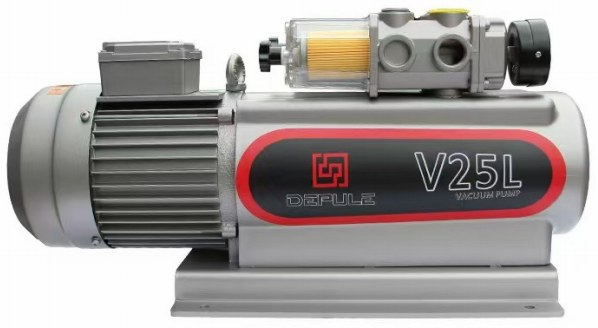
The 15, 25 and 40 m³/h band is where oil-free rotary vane pump selection gets difficult. At 40 m³/h the oil-free and oil-sealed options look similar in footprint, port size and price, yet their ultimate pressures differ by two or three orders of magnitude. Choose on pumping speed alone and the chamber may never reach the required pressure; choose on ultimate pressure alone and you pay for a range the process never uses. This article works through pump-down time, energy per cycle and leak tolerance, using the parameters of models currently in production.
1. Where the two types actually differ
| Model | Type | Speed 50/60 Hz | Power | Ultimate pressure | Noise | Weight | Inlet |
|---|---|---|---|---|---|---|---|
| DPL-V15L | oil-free | 15 / 19 m³/h | 0.35 kW | 90 mbar | 61 dB(A) | approx. 22.4 kg | G3/4″ |
| DPL-2V18 | two-stage, oil-sealed | 17 / 20.4 m³/h | 0.55 kW | 1×10⁻³ mbar | 57 dB(A) | 39 kg | NW25 |
| DPL-V25L | oil-free | 25 / 30 m³/h | 0.75 kW | 90 mbar | 62 dB(A) | approx. 26 kg | G3/4″ |
| DPL-2V28 | two-stage, oil-sealed | 27.5 / 33 m³/h | 0.75 kW | 1×10⁻³ mbar | 57 dB(A) | 44 kg | NW25 |
| DPL-V40L | oil-free | 40 / 48 m³/h | 1.5 kW | 90 mbar | 67 dB(A) | approx. 38.5 kg | G3/4″ |
| DPL-V0040A | single-stage, oil-sealed | 40 / 48 m³/h | 1.5 kW | 0.1 mbar | 62 dB(A) | 43 kg | G1 1/4″ |
90 mbar absolute is 9 kPa. One hundredth of a mbar is a nine-hundredth of that, and 1×10⁻³ mbar is roughly one ninety-thousandth. No amount of oversizing closes that gap: in an oil-free rotary vane pump the ultimate pressure is set by the clearance volume, because each revolution carries a small packet of discharge gas back into the inlet cavity. An oil-sealed pump asked to hold 50–80 mbar, on the other hand, is simply being bought for a range it will never use.
2. Pump-down time: 1 m³ from atmosphere to 50 mbar
In the rough vacuum range the isothermal approximation applies:
t = (V / S) × ln(p₁ / p₂)
With V = 1000 L, p₁ = 1013 mbar and p₂ = 50 mbar, ln(1013/50) = 3.01.
DPL-V40L: S = 40 m³/h = 11.1 L/s, so t = 1000 / 11.1 × 3.01 ≈ 271 s, about 4.5 minutes.
DPL-2V28: S = 27.5 m³/h = 7.64 L/s, so t = 1000 / 7.64 × 3.01 ≈ 394 s, about 6.6 minutes.
DPL-V0040A has the same 40 m³/h rating as DPL-V40L, so its ideal pump-down time is also 271 s. At 50 mbar there is no advantage in being oil-sealed: both pumps are still on their rated speed.
Those figures ignore the line. Standard vacuum engineering practice derates the theoretical speed to about 80% to cover pipe and valve restrictions: DPL-V40L then gives 8.9 L/s and t ≈ 338 s (5.6 min), DPL-2V28 gives 6.1 L/s and t ≈ 492 s (8.2 min). The derating is rough, but it is enough to answer the only question that matters at the quotation stage: does it finish in the cycle time or not. Long lines, small bores and several valves push it further.
Note also that 271 s is only the time to move the gas out. Wall desorption and seal leakage flatten the curve in the second half, so the stopwatch reading will be longer than the calculation, increasingly so as the pressure approaches the pump’s ultimate. ISO 21360-1:2020 (ISO/TC 112, vacuum technology) lists line resistance at low pressure, leak rate and desorption among the effects that influence the pump-down measurement, which is why a calculated time should be read as a lower bound.
3. Energy per cycle: oil-free is not the same as low-power
| Model | Power | Ideal pump-down | Energy per cycle |
|---|---|---|---|
| DPL-V15L | 0.35 kW | 722 s | 0.070 kWh |
| DPL-2V18 | 0.55 kW | 637 s | 0.097 kWh |
| DPL-V25L | 0.75 kW | 433 s | 0.090 kWh |
| DPL-2V28 | 0.75 kW | 394 s | 0.082 kWh |
| DPL-V40L / DPL-V0040A | 1.5 kW | 271 s | 0.113 kWh |
In two of the three bands the oil-sealed pump uses slightly less energy per cycle: 0.097 kWh for the 2V18 against 0.070 kWh for the V15L at the 15 m³/h end, 0.082 against 0.090 kWh at 25 m³/h, and a tie at 40 m³/h. Motor ratings are close within a band while the oil-sealed pump runs longer, and the product of power and time lands slightly lower. What an oil-free pump saves is oil, oil mist and oil-change labour — not electricity. At 200 cycles a day and 300 days a year, the 25 m³/h oil-free unit uses roughly 500 kWh more than its oil-sealed counterpart, which is the same order as a year of oil and filter changes.
4. How leak rate eats the ultimate pressure
At the edge of a pump’s capability the end pressure is a sum:
p = p_ultimate + Q / S_effective
Q is the combined leak and desorption load, S_effective the derated speed. Take Q = 5×10⁻² mbar·L/s, a level a small chamber with production-grade assembly and no helium leak test reaches easily.
DPL-2V28: S_effective = 6.1 L/s, Q/S = 0.0082 mbar. The pump is rated 1×10⁻³ mbar, so it actually settles near 9×10⁻³ mbar — almost an order of magnitude worse. To get to 1×10⁻³ mbar the leak load has to come down to the 10⁻³ range; a bigger pump does not help.
DPL-V40L: with the same Q, S_effective = 8.9 L/s and Q/S = 0.0056 mbar. Against a 90 mbar ultimate, that is invisible on a gauge. Oil-free pumps are insensitive to leak rate not because they seal better but because they start higher; an oil-sealed pump only delivers its rating on a system that is clean and leak-tested.
The same logic sets the boundary between single-stage and two-stage oil-sealed models: DPL-V0025A reaches 0.5 mbar and DPL-V0040A reaches 0.1 mbar. If the process needs 5 mbar, the V0040A is enough; if it needs 0.05 mbar, the two-stage DPL-2V18 or DPL-2V28 is the entry point.
5. Media and maintenance: vapour, dust, oil mist
ISO 21360-2:2020 defines water vapour tolerance as the maximum water vapour partial pressure that can be conveyed without condensation, and lists it as a measured characteristic of positive displacement pumps. In selection terms:
- For wet loads (drying, degassing, sealing), an oil-sealed pump relies on gas ballast to carry condensable vapour through. DPL-2V18 and DPL-2V28 reach 1.5×10⁻² mbar with ballast open, one order above their closed-ballast figure — that is the price of passing water vapour.
- An oil-free pump has no oil to emulsify, but condensate still collects in the chamber and needs a separator or periodic draining, per the unit manual.
- Dust requires an inlet filter on both types. On an oil-sealed pump a failed filter element sends dust into the oil sump, where it forms sludge and damages vanes and end plates first; on an oil-free pump the same failure wears the chamber, but there is no oil change in between.
- Oil volumes map directly to maintenance work: 0.75–1.05 L for DPL-2V18, 1.2–1.5 L for DPL-2V28, 1.5 L for DPL-V0040A, and zero for DPL-V15L, V25L and V40L.
- Noise: 57 dB(A) for DPL-2V18 and DPL-2V28 against 61–67 dB(A) for the oil-free three. Inside an enclosure the difference is small; next to an operator station it is not.
6. Decision table
| Process characteristic | Choice |
|---|---|
| Above 90 mbar: vacuum holding, clamping, thermoforming, packaging rough pump | DPL-V15L / V25L / V40L |
| 5–50 mbar, clean chamber, no oil mist allowed | DPL-V15L / V25L / V40L, one size up in speed |
| 1–10 mbar, continuous duty | DPL-2V18 / DPL-2V28 |
| 0.1–1 mbar, single stage is enough | DPL-V0025A / DPL-V0040A |
| Heavy water vapour or solvent vapour | DPL-2V18 / DPL-2V28 with gas ballast |
| Frequent relocation, multiple stations, weight sensitive | DPL-V15L (22.4 kg) |
Two hard reminders. In 60 Hz regions some models are not suitable — confirm the exact model and configuration before ordering. And do not try to buy ultimate pressure with an extra size of pumping speed: it does not work, it only adds power draw and footprint.
Estimate pump-down time with the selection calculator, and read the notes on ultimate pressure and gas ballast in the FAQ. Oil-free single-stage models: DPL-V15L, DPL-V25L, DPL-V40L. Two-stage oil-sealed: DPL-2V18, DPL-2V28. The single-stage oil-sealed range from 20 to 110 m³/h is covered by DPL-V0025A to V0100.