
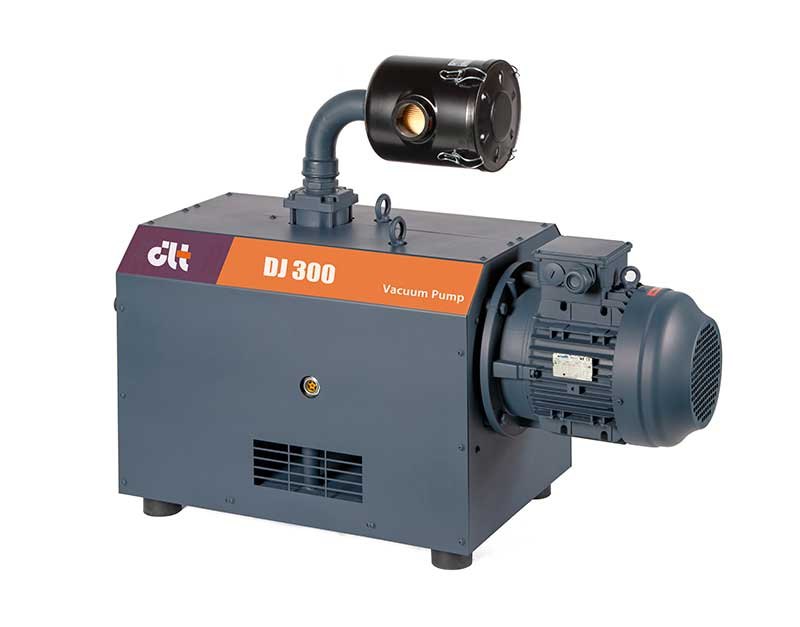
The 15–40 m³/h band is where most pump selections get argued over. Three architectures sit in it: oil-free rotary vane (DPL-V15L/V25L/V40L), single-stage oil-sealed (V0025A/V0040A) and two-stage oil-sealed (DPL-2V18/2V28). Nominal pumping speeds overlap almost completely; what the pumps can actually do differs by two to three orders of magnitude. Two worked examples below draw the line — one on pump-down time, one on leak rate.
1. Seven pumps, one table
| Model | Type | Speed 50/60 Hz (m³/h) | Ultimate | Motor | Inlet | Weight | Noise |
|---|---|---|---|---|---|---|---|
| DPL-V15L | oil-free vane | 15 / 19 | rated vacuum 90 mbar | 0.35 kW | G3/4″ | ≈22.4 kg | 61 dB(A) |
| DPL-V25L | oil-free vane | 25 / 30 | rated vacuum 90 mbar | 0.75 kW | G3/4″ | ≈26 kg | 62 dB(A) |
| DPL-V40L | oil-free vane | 40 / 48 | rated vacuum 90 mbar | 1.5 kW | G3/4″ | ≈38.5 kg | 67 dB(A) |
| V0025A | single-stage oil-sealed | 20 / 26 | 0.5 mbar (gas ballast closed) | 0.75 kW | G3/4″ | 20 kg | 62 dB |
| V0040A | single-stage oil-sealed | 40 / 48 | 0.1 mbar (gas ballast closed) | 1.5 kW | G1 1/4″ | 43 kg | 62 dB |
| DPL-2V18 | two-stage oil-sealed | 17 / 20.4 | 1×10⁻³ mbar (ballast closed) | 0.55 kW | NW25 | 39 kg | 57 dB(A) |
| DPL-2V28 | two-stage oil-sealed | 27.5 / 33 | 1×10⁻³ mbar (ballast closed) | 0.75 kW | NW25 | 44 kg | 57 dB(A) |
Two things in this table run against expectation. Oil-free does not mean quieter: the 2V18 and 2V28 are rated 57 dB(A), below the V15L at 61 dB(A) and the V40L at 67 dB(A); two stages in series mean less pressure ratio per stage and a flatter discharge pulse. Motor rating does not track speed: the V15L delivers 15 m³/h from 0.35 kW while the V0025A delivers 20 m³/h from 0.75 kW. There is no oil-film shear loss in the dry pump, and the price is paid in ultimate pressure.
2. Criterion one: the working pressure band decides who qualifies
Selection does not start with pumping speed; it starts with the pressure band. Ultimate pressure decides whether a pump may enter a band at all — pumping speed only decides how fast it works inside it.
- Rough vacuum (hundreds of mbar up to atmosphere): vacuum holding, pick-and-place air supply, folding and binding, laminating, packaging. The DPL-V15L/V25L/V40L are built for exactly this; the product pages list die bonders, mounters, robots, exposure machines, laminators and folding machines.
- Low vacuum (0.5 to 90 mbar): single-stage oil-sealed territory. V0025A reaches 0.5 mbar with the gas ballast closed; V0040A and above reach 0.1 mbar, returning to 0.5 mbar with ballast open for small condensable loads.
- High-vacuum backing (below 0.1 mbar): two-stage 2V18/2V28 at 1×10⁻³ mbar; below that, 2V80/2V275 at 4×10⁻⁴ to 5×10⁻⁴ mbar, or a two-stage backing a Roots blower.
Between 90 mbar and 1×10⁻³ mbar there are five orders of magnitude. Once the duty sits below 90 mbar, no amount of extra speed makes an L-series pump reach it — the rest of the calculation is moot.
3. Criterion two: cleanliness rules the oil-sealed pumps out
The L series is oil-free: no oil mist, no oil suck-back at shutdown. Oil-sealed pumps carry a suck-back risk at the moment of stopping, which electronics assembly, die bonding, food and pharmaceutical stations cannot accept — so those stations use the L series and give up everything below 90 mbar. That is a hard constraint, independent of price, speed or footprint.
The reverse also holds: the L series is limited to clean air and other dry, non-toxic, non-corrosive, non-flammable gases. Where dust or water vapour is present, oil-sealed pumps offer gas ballast (from V0040A upward, 0.5 mbar with ballast open) to handle small condensable loads; the oil-free L series has no such means and needs filtration or a cold trap ahead of the inlet.
4. Example one: how long does a 60 L fixture take to reach 300 mbar
Isothermal estimate: t = (V ÷ S) × ln(p1 ÷ p2), where V is volume, S effective pumping speed.
A vacuum fixture plus piping of V = 60 L, pumped from 1013 mbar down to 300 mbar:
ln(1013 ÷ 300) = ln 3.377 = 1.217
On nominal speed (optimistic)
- DPL-V25L: S = 25 m³/h = 6.94 L/s, t = (60 ÷ 6.94) × 1.217 = 10.5 s
- DPL-V15L: S = 15 m³/h = 4.17 L/s, t = (60 ÷ 4.17) × 1.217 = 17.5 s
- DPL-V40L: S = 40 m³/h = 11.11 L/s, t = (60 ÷ 11.11) × 1.217 = 6.6 s
On effective speed (this is what you size a cycle on)
Nominal speed is measured at the pump inlet. Line losses, G3/4″ fittings, solenoid valves and leakage at the cup-to-workpiece interface all reduce the speed seen by the fixture. In rough vacuum the conductance penalty is modest, so a factor of 0.6 is a safe allowance:
- V25L: 4.17 L/s → t = 17.5 s
- V15L: 2.50 L/s → t = 29.2 s
- V40L: 6.67 L/s → t = 10.9 s
A 12 s cycle target: the V15L misses by more than double, the V25L by 5.5 s, the V40L sits right on the line. Before buying a bigger pump, cut the volume from 60 L to 40 L — shorter hoses, no intermediate reservoir, valve block close to the fixture — and the V25L drops to (40 ÷ 4.17) × 1.217 = 11.7 s, on target.
Fixture volume is the first variable and pump size the second. Reducing bore raises flow resistance, which matters little in rough vacuum, but do not go two sizes below the pump inlet.
5. Example two: the same leak, two very different margins
No circuit is perfectly tight. Quantify it with the static pressure-rise method: close the inlet valve and record the rise.
Q = V × Δp ÷ Δt
With V = 60 L and a rise from 300 to 316 mbar over 300 s, Δp = 16 mbar:
Q = 60 × 16 ÷ 300 = 3.2 mbar·L/s (0.32 Pa·m³/s)
Now compare with what a pump can swallow: Q = p × S.
- V25L at 300 mbar: Q = 300 × 4.17 = 1251 mbar·L/s. The leak is 3.2 ÷ 1251 = 0.26% of capacity; the working point barely moves.
- 2V18 at 1 mbar: S = 17 m³/h = 4.72 L/s, Q = 1 × 4.72 = 4.72 mbar·L/s. The leak takes 68% of capacity and the equilibrium pressure is 3.2 ÷ 4.72 = 0.68 mbar — this pump cannot reach 1 mbar on this circuit, let alone the 1×10⁻³ mbar on its nameplate.
To bring a 2V18 to 1×10⁻³ mbar the allowable leak must fall to 1×10⁻³ × 4.72 = 4.7×10⁻⁴ mbar·L/s, 680 times smaller than 3.2.
That factor of 680 is where connection standards come from: a G3/4″ thread with a wire-braided hose is fine for the L series, but anything below 1 mbar needs NW25 flanges, metal tubing, welded or metal-sealed joints and leak testing. Pick the pump by pressure band, then let the pump set the piping class — doing it the other way round means rework.
6. Criterion three: noise, weight, supply and maintenance
- Noise: allow for the V40L’s 67 dB(A) when the pump sits inside a machine — distance and enclosure follow the higher figure. The 2V18/2V28 at 57 dB(A) are quieter at comparable speed, so if noise is the binding constraint, two-stage wins.
- Weight: V15L ≈22.4 kg, V25L ≈26 kg, V40L ≈38.5 kg, against 39 kg for the 2V18 and 44 kg for the 2V28. On a robot-mounted or overhead station, that difference goes straight into the bracket.
- Supply: the L series accepts 220–240 V or 380–450 V, single- or three-phase; V0025A is single-phase 220/240 V (three-phase optional); from V0040A upward it is three-phase; 2V18/2V28 are single-phase 220 V or three-phase 380 V. No three-phase supply on site and only a 0.35 kW load — the V15L drops the transformer and VFD.
- Maintenance: oil-sealed pumps need oil and exhaust filters — 0.75 L in the V0025A, 1.5 L in the V0040A, 0.75–1.05 L in the 2V18, 1.2–1.5 L in the 2V28. The oil-free L series needs no oil, but the vanes remain wear parts and are scheduled by running hours and dust load.
- 60 Hz: L series speeds at 60 Hz are 19/30/48 m³/h. Confirm before ordering a 60 Hz version; some models are not suited to 60 Hz regions, so check model by model with the factory.
7. Selection order
- Set the pressure band. Can the duty stay above 90 mbar? If yes, the L series is a candidate; if not, go straight to single-stage (0.1–0.5 mbar) or two-stage (1×10⁻³ mbar).
- Work out volume and cycle time. Use t = (V ÷ S) × ln(p1 ÷ p2) with S at 60% of nominal. Shrink the fixture volume before changing the pump model.
- Check the leak rate. Measure Q by pressure rise and compare with p × S; if the margin is under one order of magnitude, fix the circuit rather than upsizing the pump.
Get those three numbers and usually only one model is left standing. Ask only “how many litres per minute” and the job comes back for rework. Use the pump-down calculator for a first pass and the FAQ for connection details; for the wider comparison by cleanliness, maintenance and gas handled, see oil-free vs oil-sealed rotary vane pumps.