
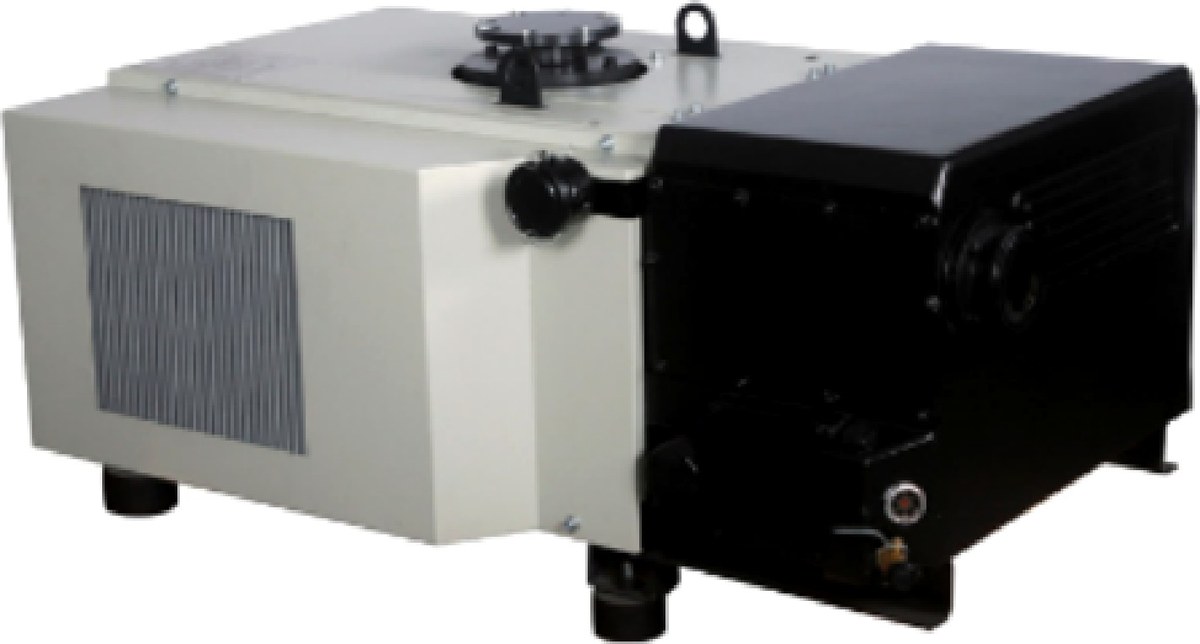
On an oil-sealed rotary vane pump, a loaded oil mist separator (exhaust filter) rarely announces itself. Vacuum drifts first, pump temperature climbs, and eventually the motor trips on overload. Most plants replace the element only after that trip. Three quantities measurable on site would have shown the problem earlier — ultimate pressure, pump-down time and exhaust differential pressure — and all three can be calculated rather than guessed.
1. Why a clogged element shows up first in ultimate pressure
Exhaust gas leaves an oil-sealed pump through the coalescing element, which traps oil mist and returns it to the oil sump. As sludge, dust and condensate blind the media, flow area shrinks and exhaust back pressure rises. Ultimate pressure of a rotary vane pump is not zero; it is set by exhaust pressure divided by the built-in compression ratio:
p_ult = p_exh / K
Nameplate ultimate pressure is measured with the exhaust at atmosphere (1013 mbar), so the nominal ratio can be back-calculated:
| Model | Ultimate pressure (gas ballast closed) | Implied K |
|---|---|---|
| DPL-V0025A | 0.5 mbar | 2.0×10³ |
| DPL-V0040A | 0.1 mbar | 1.0×10⁴ |
| DPL-V0100 | 0.1 mbar | 1.0×10⁴ |
| DPL-V0155 | 0.3 mbar | 3.4×10³ |
| DPL-V630B | ≤8×10⁻² mbar | 1.3×10⁴ |
Worked example 1 — DPL-V0040A, K ≈ 1.0×10⁴. With a 47 mbar drop across the element, back pressure becomes 1060 mbar:
p_ult = 1060 ÷ 10130 = 0.105 mbar
That is 4.6% above the 0.1 mbar nameplate value. Run the same expression across a range of back pressures: 1013 → 0.100 mbar, 1030 → 0.102, 1060 → 0.105, 1100 → 0.109, 1150 → 0.114 mbar.
The useful direction is the reverse one. If measured ultimate pressure falls from 0.1 to 0.13 mbar, up 30%, back pressure is up 30% too — about 1317 mbar, meaning roughly 300 mbar across the element. A gauge reading of 300 mbar is quantitative evidence of blockage, not an opinion. Note that the back-calculated K is nominal: oil temperature, oil condition and gas ballast shift it, so read trends over a week rather than a single point.
2. Signal two: longer pump-down, back-calculated to effective pumping speed
Piping, valves and the element all consume pumping speed, so the chamber sees less than the nameplate figure at the pump inlet. Instead of estimating a derating factor, measure it:
S_eff = V × ln(P0 / P1) ÷ t
Worked example 2 — chamber volume 1.0 m³, 1013 to 10 mbar, DPL-V0100 rated 100 m³/h at 50 Hz. The target sits two decades above ultimate pressure, so that term drops out:
ln(1013 ÷ 10) = ln 101.3 = 4.618 t = 3600 × 1.0 × 4.618 ÷ 100 = 166 s ≈ 2.8 min
If the plant measures 235 s instead:
S_eff = 3600 × 1.0 × 4.618 ÷ 235 = 70.7 m³/h
Only 71% of nameplate. After a new element, the same test reads 172 s → 96.7 m³/h, back to 97%. Same chamber, same pump, same gauge: “vacuum doesn’t feel like it used to” becomes “effective pumping speed is down 29%”.
On a production line that adds up. At 63 s extra per cycle and 45 cycles a day, that is 47 minutes of extra pump-down daily, about 20 hours a month over 26 working days. The element costs far less than that lost time.
3. Signal three: differential pressure and motor current
- Differential gauge: record the pressure drop when the element is new, then replace at three times that baseline or at the manual’s limit. Published maintenance guides quote anywhere from 5–8 kPa to 0.5 bar; the spread comes from element flow area and pump size, which is why a recorded baseline beats copying someone else’s number.
- Motor current: rising back pressure raises rotor resistance; running current 10–15% above rated is a common band. Where a VFD or ammeter is fitted, trend-watching answers the question without stripping the pump.
- Visual: mist at the exhaust or oil traces on the upper housing means the element is no longer separating; oil is being carried out. Check the oil return line at the same time.
- Temperature: a hot pump body in continuous duty is a consequence of back pressure, not an independent fault — do not treat it only as a cooling problem.
4. Setting the replacement interval
Our published service guidance is 1000–2000 h for the mist separator and 500–2000 h (or every six months) for the oil; halve both for dusty, humid or 24-hour duty. In practice: clean gas and 8-hour intermittent operation can run to 2000 h but replace early if differential pressure says so; gas ballast open on water vapour or solvent vapour means 1000 h; coating, heat treatment or dusty duty means half of that plus a differential gauge; corrosive or condensable media mean a shorter interval and more frequent oil checks.
Tracking only hours has two flaws: pumps are not always run to the hour meter’s assumption, and mist load varies several-fold between processes. Record three things on the maintenance card — date, running hours, baseline differential — and manage on the pressure trend with hours as a secondary trigger.
5. Six steps when changing the element
- Stop the pump, vent the chamber, and work while the body is still warm — seals are softer and tear less.
- Never wash and refit a coalescing element; cleaning destroys the coalescing layer, raising pressure drop while lowering separation efficiency.
- Do not blow compressed air through from the outside; it punctures the media and lets fine mist straight through.
- Fit a new O-ring, lubricate it with pump oil, and tighten bolts diagonally and evenly. A cocked cover leaks, and a leak corrupts every differential reading afterwards.
- Check the oil return capillary. If it is blocked, oil leaves through the exhaust instead of returning to the sump, and even a new element will not last. It also shows up as abnormal oil consumption.
- Run unloaded for 10–15 minutes, read the differential, and write it down as the new baseline.
An element change does not automatically require an oil change. Oil charge varies by model: DPL-V0025A 0.75 L, DPL-V0040A 1.5 L, DPL-V0063 and DPL-V0100 2 L each, DPL-V0155 4 L, DPL-V630B 20 L (23 L supplied). If the oil is black, cloudy or emulsified, change both.
6. When the problem is not the element
If a new element and good oil still leave ultimate pressure well above nameplate, the fault is inside the pump: worn vanes opening the clearance and allowing back-leakage from the high side, degraded oil losing its sealing film, or a leak at the inlet or end cover. Close the valve and measure the rate-of-rise to separate internal from external leakage, then follow our notes on five measurable signs of vane wear and back-calculating effective pumping speed to decide on vane replacement.
Take supply frequency into account when setting a baseline: DPL-V0100 moves 110 m³/h at 60 Hz against 100 m³/h at 50 Hz. Some models are not suitable for 60 Hz supply; confirm motor and speed configuration with the factory before ordering.
Used together, the three signals give a defensible replacement decision: differential pressure measures blockage, pump-down time measures speed loss, ultimate pressure converts back to back pressure. When all three point the same way, change the element. When they disagree, check the oil return line, oil condition and leaks before stripping the pump.
Related pages
- V0025A to V0100 single-stage oil-sealed rotary vane pumps
- DPL-V0155 single-stage oil-sealed rotary vane pump, 150 m³/h
- DPL-V630B oil-sealed single-stage rotary vane pump, 700 m³/h
- Pumping speed and pump-down calculator
- FAQ
Related reading
- Is 0.1 mbar enough for a coating backing pump
- How to Choose Vacuum Pump Oil and When Oils Can Be Mixed
- When to open the gas ballast valve, and for how long
- V0025A-V0100 single-stage oil-sealed vane pumps
- V0155 single-stage oil-sealed vane pump 150 m³/h
- DPL-V630B Oil-Lubricated Single-Stage Rotary Vane Pump