
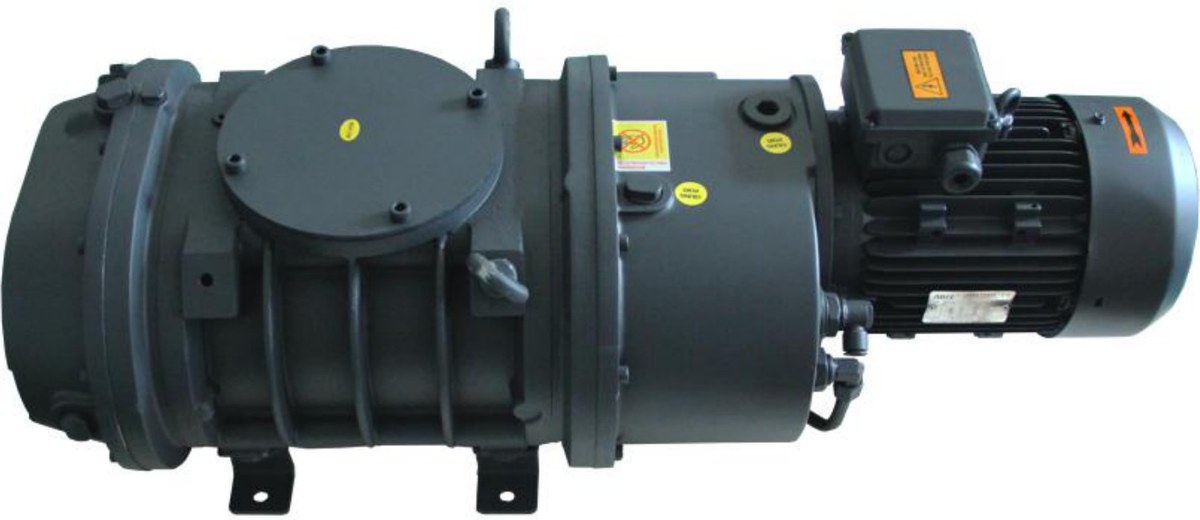
Field diagnosis of an overheated Roots pump often ends at “the motor is too small”. That is rarely the cause. In a Roots blower the rotors run without contact and the pump does no internal compression: it moves gas from the low-pressure side to the high-pressure side, and the heat comes from work done against the pressure difference. Four causes cover most cases: excessive pressure differential, wrong starting point, insufficient cooling, and lubrication or clearance problems.
1. Excessive pressure differential
There is no internal compression, so the discharge pressure is set by the backing pump. The compression work can be estimated isothermally:
P = p₁ × S × ln(p₂ / p₁)
Example: LC2600 at 10 mbar inlet (1 kPa), compression ratio 4, pumping speed 2600 m³/h = 0.722 m³/s:
P = 1000 Pa × 0.722 m³/s × ln4 ≈ 1.0 kW.
The same LC2600 at 30 mbar inlet (3 kPa), ratio 3:
P = 3000 × 0.722 × ln3 ≈ 2.4 kW.
The motor is rated 7.5 kW, so 2.4 kW is already spent on the pressure difference — no extra pumping speed, only heat.
The differential usually grows because the backing pump is underperforming. The LC series Roots pumps are normally paired at a speed ratio of 2 to 3 for continuous duty; above 4 the pairing is at its limit. LC2600 (2600 m³/h) with a V0630B (630 m³/h) is a ratio of 4.1 and is recommended for intermittent pumping only. Emulsified oil, a clogged inlet filter or a leaking line all lower the effective backing speed and push the compression ratio up.
There is a second factor at low pressure: the gas mass flow is small. At 10 mbar, 2600 m³/h corresponds to roughly 0.0086 kg/s. Carrying away 1.0 kW with the gas alone would need a rise of about 116 K (c_p ≈ 1.005 kJ/(kg·K)). The gas cannot remove much heat, so the casing and the cooling circuit have to do it — once the differential exceeds the design point, it shows up as temperature.
2. Starting before the inlet pressure is low enough
A Roots pump must not start against atmosphere. Switching it in at a few hundred mbar puts the full differential on the rotors and current and temperature rise together. The usual sequence is: the backing pump pulls the system down to 10–30 mbar, then the Roots pump starts, with an inlet-pressure interlock so it cannot start earlier. Fit the pressure transmitter on the Roots pump inlet, not on the backing pump discharge, or you measure back pressure instead of inlet pressure.
3. Cooling and heat dissipation below spec
- Air-cooled units: dust on the fins, poor room ventilation and high ambient temperature all cut heat rejection.
- Water-cooled units: low flow, high inlet water temperature and scale in the circuit reduce heat exchange. Check flow and allowable pressure against the unit data; if the outlet water stays hot, look at the circuit first.
- Shutdown order: stop the Roots pump first and let the backing pump clear the chamber, otherwise heat stays trapped in the pump.
4. Lubrication and clearance problems
Oil volumes differ between LC models, and a shortage heats the gears and bearings first, then the pumping chamber:
| Model | Shaft seal chamber | Gear box | Gear chamber |
|---|---|---|---|
| LC250 / LC500 | 0.125 L | 0.15 L | — |
| LC1200 | 0.125 L | 2.4 L | 1.25 L |
| LC2600 / LC4200 | 0.45 L | 6.5 L | 3.5 L |
Low oil level or degraded, coked oil hurts lubrication and heat transfer at the same time. The other case is reduced clearance: dust or condensable vapour deposits on the rotors and chamber walls, the clearance is used up and friction heats the pump. This kind of overheating usually comes with more noise and vibration and needs a shutdown inspection.
Troubleshooting order
- Record inlet and discharge pressure, calculate the actual compression ratio and compare with the design value.
- Check the backing pump: pumping speed, oil condition, filter condition.
- Measure temperatures at the gear box, bearings and discharge to locate the hot spot.
- On water-cooled units check flow and water temperatures; on air-cooled units check fins and room temperature.
- Shut down and check oil level and oil condition, then open the chamber for foreign matter and rotor marks.
A larger motor does not fix this: the heat from the pressure difference stays and the undersized backing pump is hidden.
Size the heat budget at the selection stage
Choose the model by the working pressure point, then verify the backing pump speed at the same point. Use a speed ratio of 2–3 for continuous duty and 3–4 only for intermittent pumping. Take the highest differential the process can produce, multiply by 1.3 and check against the allowable value instead of running at the limit. Packaged arrangements are available as vacuum pump units, and pump-down time can be estimated with the selection calculator. Some models are not suitable for 60 Hz regions; please confirm the applicable model and configuration before ordering.