
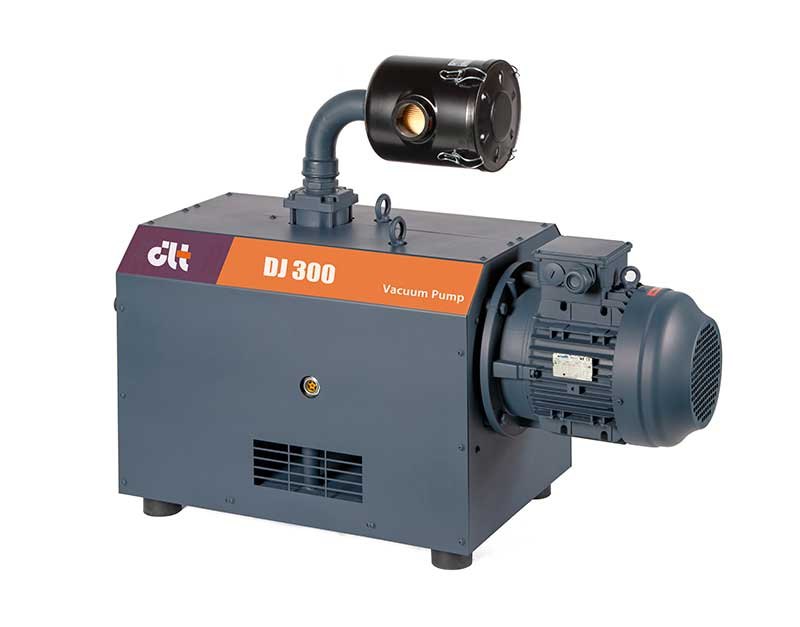
A pump sent to the Middle East, North America or Southeast Asia never matches the domestic datasheet on the nameplate, and the question arrives with almost every inquiry. The pump body is the same; the grid is not. A 50 Hz motor and a 60 Hz motor differ by 20% in synchronous speed, displaced volume follows the speed, and power, noise and temperature rise move with it.
Three things need re-checking before quoting: which pumping speed to use, whether the motor has to change, and how voltage and wiring are verified. Every figure below comes from the 50/60 Hz columns on the product pages.
1. Start with speed
Synchronous speed of an induction motor is proportional to frequency: n = 120f / p. A four-pole machine runs 1500 r/min at 50 Hz and 1800 r/min at 60 Hz, with slip bringing the nameplate value below that. Where both figures are published, read them directly: DPL-2V18 and 2V28 at 1440 / 1720 r/min, DPL-ZS150 at 2950 / 3600, DPL-WSU2000 at 3000 / 3600.
The oil-free V series (V8, V10, V16, V25, V40 and the L versions) lists 1420 r/min at 50 Hz only; the 60 Hz speed depends on the motor finally fitted. Confirm it when ordering instead of calculating 1704 r/min.
2. Pumping speed rises by 1.10 to 1.30, not by one factor
| Model | 50 Hz | 60 Hz | Ratio |
|---|---|---|---|
| V0025A | 20 | 26 | 1.30 |
| V8 | 6.8 | 8.6 | 1.26 |
| ZS150 | 140 | 175 | 1.25 |
| V0063 | 63 | 75 | 1.19 |
| V0155 | 150 | 175 | 1.17 |
| V16 | 16 | 18.2 | 1.14 |
| V40 | 40 | 45 | 1.13 |
| V0100 | 100 | 110 | 1.10 |
| LC1200 | 1200 | 1440 | 1.20 |
A 20% speed increase lifts theoretical displacement by 20%, but clearance back-flow, valve resistance and vane tip leakage do not scale with it. Small pumps have little geometric flow, so losses take a larger share and the ratio comes out higher (V0025A at 1.30). Large pumps carry more absolute leakage and effective speed is held back (V0100 at 1.10).
Roots units stay at 1.20: LC250 250/300, LC500 500/600, LC1200 1200/1440, LC2600 2600/3120, LC4200 4200/5040 m³/h. The rotors run without contact, so clearance back-flow is small against total throughput.
3. Example one: the same pump on two grids
A packaging station with 0.5 m³ of chamber and piping, pumped from 1000 mbar to 300 mbar, fitted with a DPL-V25 (25 / 30 m³/h). Using the isothermal estimate t = (V ÷ S) × ln(p1 ÷ p2):
- 50 Hz: S = 25 ÷ 3600 = 0.00694 m³/s, t = 72.0 × 1.204 = 86.7 s
- 60 Hz: S = 30 ÷ 3600 = 0.00833 m³/s, t = 60.0 × 1.204 = 72.2 s
That is 14.4 s per cycle, or 14 minutes lost every hour at 60 cycles per hour. The reverse case matters more: equipment timed on 60 Hz data and shipped to a 50 Hz site is that much slower, so ask for the site frequency at quotation stage.
4. Example two: where a flat 1.2 factor breaks
A duty needs 105 m³/h of net pumping speed at a 60 Hz site. With ×1.2, V0100 computes to 120 against a table value of 110, 9% high; V40 computes to 48 against 45, 6.7% high. The other direction costs money as well: V0025A computes to 24 against 26, 7.7% low. Read the table; use 1.2 only as a sanity check.
5. Motor power: ZS150 needs the larger frame
A 20% higher frequency does not raise shaft power by 20%. ZS150 is documented at 3.5 kW for 50 Hz and 4.8 kW for 60 Hz, a 37% increase — in a dry-running pump with an oil-free chamber, compression heat and clearance back-flow losses climb quickly with speed. For a 60 Hz ZS150, specify motor, supply and thermal protection at the 4.8 kW level.
Other models list 50 Hz power only (V8 0.28 kW, V16 0.38 kW, V25 0.75 kW, V40 1.5 kW, V0100 3.0 kW, V630B 15 kW); whether 60 Hz keeps the same rating is confirmed against the motor fitted.
6. Voltage, noise and connections
- Voltage: LC series 220-240 V / 380-415 V / 460 V three-phase, 460 V being common in 60 Hz markets. 2V80, 2V275 and V0160–V0302 are 220/240 V and 380/415 V, so a 460 V site must be stated up front. V630B comes in 380-400 V, 660-690 V and 415 V.
- Noise: V0160 is listed at 70/72 dB and V0302 at 74/76 dB, about 2 dB higher at 60 Hz. Size room treatment and operator distance on the higher figure.
- Connections: G3/8″, G3/4″, G2″ and DN100 do not change with frequency, but terminal box orientation and fan cowl clearance can. Check the outline drawing before packing.
7. Three items to confirm before ordering
- Some LC Roots models are not suited to 60 Hz regions, as noted on the product page. Confirm model by model, not by series.
- The 60 Hz speed and power of the oil-free V series are not fully published; confirm against the configuration ordered.
- When 60 Hz, a non-standard voltage and a non-standard connection appear together, confirm configuration and lead time together.
Three inputs settle the selection: site frequency and voltage, required pumping speed and target pressure, gas handled and continuous running hours. Get the frequency wrong and everything downstream is recalculated.