
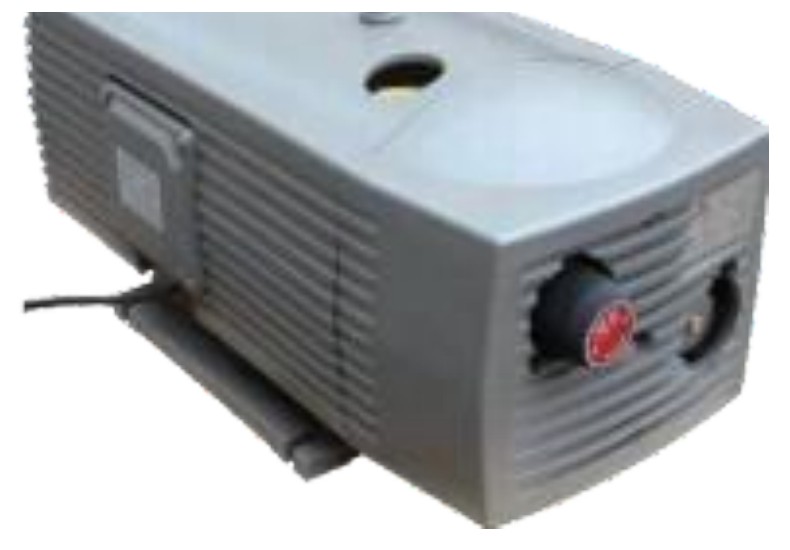
Choosing an oil-free rotary vane pump starts with a pumping speed number, but that number is only the entry point. From V3 to DPL-V40 the range covers nine frame sizes: 3.4 to 40 m³/h, 0.18 to 1.5 kW, G1/4″ to G3/4″ inlet. Too small and the chamber never reaches target; too large and you pay for power, weight, noise and floor space you do not need. Three calculable boundaries — pump-down time, pipe velocity and vacuum level — cut the range into usable steps.
1. The nine frame sizes on one table
| Model | Speed 50/60 Hz (m³/h) | Rated vacuum | Inlet | Power (kW) | Weight (kg) |
|---|---|---|---|---|---|
| V3 | 3.4 / 4.2 | 90 kPa (gauge vacuum) | G1/4″ | 0.18 | 8.2 |
| DPL-V8 | 6.8 / 8.6 | 100 mbar | G3/8″ | 0.28 | 11.5 |
| DPL-V10 | 10 / 12 | 100 mbar | G3/8″ | 0.3 | 15 |
| DPL-V16 | 16 / 18.2 | 100 mbar | G3/8″ | 0.38 | 18.5 |
| DPL-V15L | 15 / 19 | 90 mbar | G3/4″ | 0.35 | approx. 22.4 |
| DPL-V25L | 25 / 30 | 90 mbar | G3/4″ | 0.75 | approx. 26 |
| DPL-V25 | 25 / 30 | 850 mbar (gauge) | G3/4″ | 0.75 | 26 |
| DPL-V40L | 40 / 48 | 90 mbar | G3/4″ | 1.5 | approx. 38.5 |
| DPL-V40 | 40 / 45 | 850 mbar (gauge) | G3/4″ | 1.5 | 38.5 |
Three things stand out. Same speed does not mean same pump: DPL-V25L and DPL-V25 share 25 / 30 m³/h, 0.75 kW and G3/4″, but one is rated 90 mbar absolute and the other 850 mbar gauge — not interchangeable. At 60 Hz the speeds rise 14 to 27 percent, mostly around 20 percent: V3 from 3.4 to 4.2, DPL-V16 from 16 to 18.2, DPL-V40L from 40 to 48. Some models are not suited to 60 Hz areas — confirm motor and speed configuration with us before ordering.
2. Three ways of writing “vacuum” — convert before comparing
V3 is listed as 90 kPa of gauge vacuum; DPL-V8, V10 and V16 as 100 mbar absolute; DPL-V15L, V25L and V40L as 90 mbar absolute; DPL-V25 and V40 as 850 mbar gauge (the product page states approximately 150 mbar absolute). The large 850 is the loosest figure of the set, not the tightest: convert everything to absolute first. A sensible working point for this family sits between 150 and 300 mbar; the V3 page recommends keeping normal duty within 85 kPa of gauge vacuum.
3. Pump-down example: 50 L from atmosphere to 200 mbar
Use t = (V / S) × ln(p1 / p2), with V in litres and S in L/s (m³/h divided by 3.6). For 50 L from 1013 to 200 mbar, ln(1013/200) = 1.622:
| Model | Nominal speed (L/s) | Ideal time | With pipework and efficiency allowance (×1.25) |
|---|---|---|---|
| V3 | 0.94 | 86 s | approx. 107 s |
| DPL-V8 | 1.89 | 43 s | approx. 54 s |
| DPL-V10 | 2.78 | 29 s | approx. 37 s |
| DPL-V16 | 4.44 | 18 s | approx. 23 s |
| DPL-V25L | 6.94 | 12 s | approx. 15 s |
| DPL-V40L | 11.1 | 7 s | approx. 9 s |
The allowance is not arbitrary: pipe conductance, valve bore and inlet filtration all take their share, and the pump’s own speed falls away near its ultimate pressure. Use 1.2 to 1.3, or back-calculate from a measured pump-down on site (the calculator page does the arithmetic).
4. Larger chambers change the answer
For a 600 L chamber to 200 mbar, DPL-V40L needs 600 ÷ 11.1 × 1.622 ≈ 88 s ideal, about 110 s with the allowance. To hit 90 s, the required speed is S = 600 ÷ 90 × 1.622 ≈ 10.8 L/s, or 38.9 m³/h — already at the nominal figure, so the allowance leaves it short. That is the top of this range: beyond 40 m³/h you change pump type, not frame size. Move to the single-stage oil-sealed V0155 / V0160 band (150–160 m³/h) or use a unit with a buffer tank to cover the peak.
5. Check pipe velocity, not just the thread
Size the line to the pump inlet, then check v = Q / A. Rough-vacuum lines are normally kept at 10–20 m/s; above 30 m/s the pressure drop becomes visible and bends make it worse:
| Case | Pump speed | Pipe bore | Velocity |
|---|---|---|---|
| V3 with G1/4″ pipe | 0.94 L/s | 6.5 mm | 28 m/s |
| DPL-V8 with G3/8″ pipe | 1.89 L/s | 9.5 mm | 27 m/s |
| DPL-V16 with G3/8″ pipe | 4.44 L/s | 9.5 mm | 63 m/s |
| DPL-V16 with G3/4″ pipe | 4.44 L/s | 19 mm | 16 m/s |
| DPL-V40L with G3/4″ pipe | 11.1 L/s | 19 mm | 39 m/s |
| DPL-V40L with G1″ pipe | 11.1 L/s | 25 mm | 23 m/s |
DPL-V8 at G3/8″ is already at 27 m/s — acceptable on a short run. From DPL-V16 upward the line must go to G3/4″; at 63 m/s the pipework swallows a large part of the pump’s capacity and a bigger pump will not help. DPL-V40L at G3/4″ runs at 39 m/s: fine under 2 m of pipe, but use G1″ or DN40 beyond 5 m. See also /news/piping-and-valves/.
6. Handling duty: the leak, not the chamber, sets the size
Vacuum gripping is not a sealed chamber — it is a system that leaks continuously. Porous workpieces (cardboard, textiles, breathable packaging, corrugated board) can leak at a rate close to the pump’s nominal speed, so the question is how much leakage the pump can carry, not how big the volume is.
Holding force follows F = 0.1 × p × S × n (p in kPa, S in cm² per cup, n cups). Six 50 mm cups at 60 kPa: 19.6 cm² per cup, F = 0.1 × 60 × 19.6 × 6 ≈ 707 N, about 72 kg theoretical; with a 1.5 safety factor the usable load is around 470 N. The pump’s job is to hold that 60 kPa. V3 delivers 0.94 L/s, so roughly 1 L/s of leakage through pipework and cups consumes the entire margin and the vacuum sags below setpoint. In this band the difference between DPL-V8 and DPL-V16 is less about pumping fast and more about how much leakage each can carry — pneumatic selection guides treat leakage (QL) as a separate term alongside volume in the response-time formula for exactly this reason.
7. Where to go when this range is not enough
Three boundaries. For lower pressure, this family stops at 90–100 mbar absolute; the single-stage oil-sealed V0040A to V0100 reaches 0.1 mbar and the two-stage DPL-2V18 reaches 1×10⁻³ mbar. For more speed, 40 m³/h is the ceiling; the next step is the 150–340 m³/h oil-sealed band or a packaged unit. For clean duty at higher flow, the dry claw DPL-ZS150 and ZS300 cover 140–300 m³/h with an oil-free chamber, but their ultimate vacuum of 60–150 mbar does not replace a high-vacuum stage.
Maintenance on this family sits in three places: inlet filtration, cooling and vane wear (see /news/oil-free-vane-benefits/). No oil circuit, no waste-oil disposal — that is why it holds its place in the rough and medium vacuum range. Run the four examples above before picking a frame size from the catalogue.