
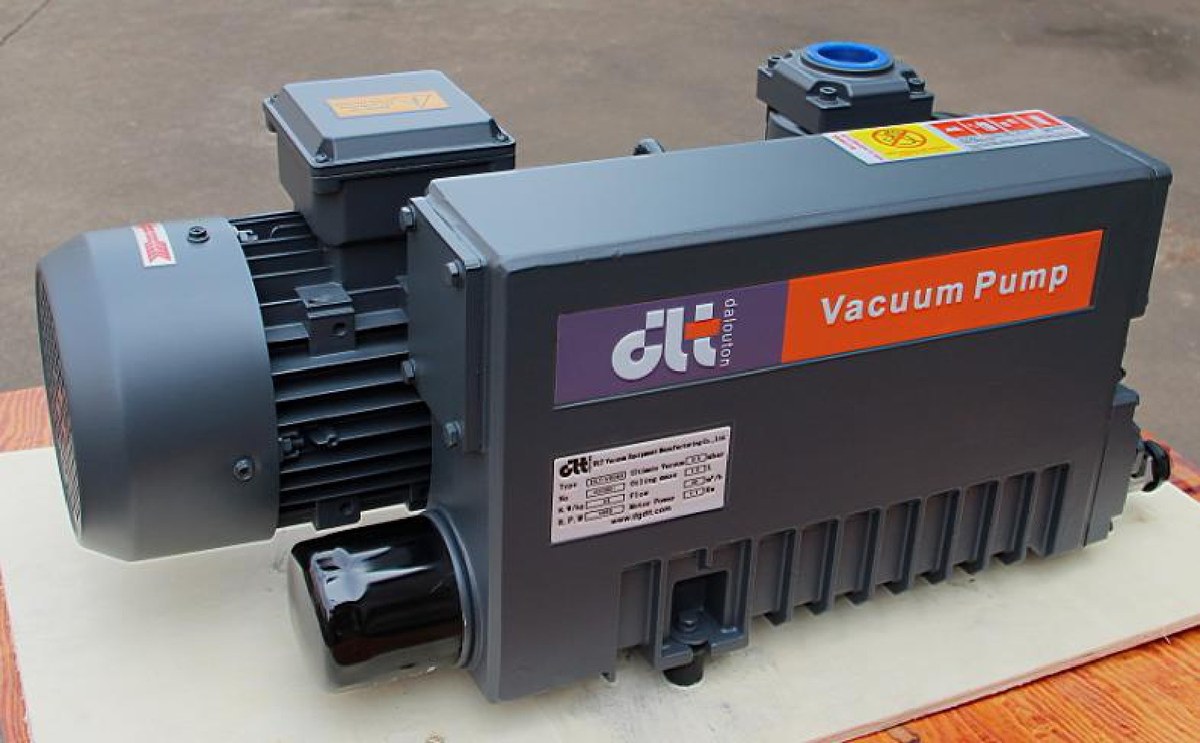
Most pump selection errors are not pump faults — they are duty data that was never collected. The pumping speed and ultimate pressure on a data sheet are measured under standard conditions; on site they pass through piping conductance, gas composition and duty cycle before they reach the chamber. Settle the six items below and the model range narrows by itself. Skip them and the quoted model rests on assumptions.
1. Working pressure, not the data-sheet ultimate
What matters is the pressure the chamber must hold during steady production, not the lowest number the pump reaches on a clean, isolated inlet. Keep the working point roughly one order of magnitude above the ultimate so the pump runs near its rated speed. At a 0.1 mbar working point, the DPL-V0025A with a 0.5 mbar ultimate no longer moves gas — pressure is held only by leakage and desorption. DPL-V0040A through DPL-V0100 reach 0.1 mbar with the gas ballast closed, but that is the ultimate itself with no margin. For 10⁻³ mbar processes, two-stage pumps are the better fit: DPL-2V18 at 17 m³/h and DPL-2V28 at 27.5 m³/h, both with a 1×10⁻³ mbar ultimate. See /products/dp-v0020-v0100/ and /products/dp-2v80-2v275/.
2. Chamber volume and pump-down time set the pumping speed
With volume and target pressure known, the speed follows from t = (V / S_eff) × ln(P₀ / P₁). For a 1,000 L chamber going from atmosphere (1,013 mbar) to 1 mbar the log term is 6.92. A DPL-V0040A at 40 m³/h is 11.1 L/s; allowing 70 % for valve and pipe losses, 7.8 L/s effective, gives t ≈ 1,000/7.8 × 6.92 ≈ 890 s, close to 15 minutes. A DPL-V0100 at 100 m³/h (27.8 L/s, about 19.4 L/s effective) does the same job in roughly 356 s, under six minutes.
The difference between the two pumps is cycle time, not vacuum level. Four cycles an hour with nine extra minutes each costs six hours a day; conversely, a 100 m³/h pump on intermittent small batches buys speed and noise that never get used. Work the number backwards on /calculator/, then check it against a measured speed curve.
3. Gas composition decides whether the pump survives its warranty
Dry air and a stream carrying water vapour, dust or corrosive components need different configurations. With water vapour or solvent vapour, open the gas ballast: the ultimate of DPL-V0040A to DPL-V0100 moves from 0.1 mbar to 0.5 mbar, and the DPL-V630B from ≤8×10⁻² mbar to ≤0.7 mbar. That penalty has to be budgeted into the working point in advance. Dust requires an inlet filter, with rating and change interval set by the dust load. Corrosive media are handled through materials and seals — a larger pump does not solve them. ISO 21360-2 lists water vapour tolerance among the performance figures to be measured on positive displacement pumps, so the number should be obtainable from the supplier.
4. Continuous or intermittent duty
The same pumping speed leaves different margins depending on duty. An oil-sealed vane pump running continuously sits at a higher, steadier body temperature and takes up water vapour into the oil more readily. A roots set is limited by permissible differential pressure: the speed ratio (booster speed ÷ backing pump speed) is normally 2–4, and above 4 the differential is large enough that thermal growth of the rotors can bring them into contact with the casing, so only short pumping cycles are advisable. LC2600 (2,600 m³/h) with a V630B (630 m³/h) is a ratio of 4.1 — an intermittent arrangement; continuous processes are better served at 2–3. Details under /products/dp-lc-roots/.
5. Supply voltage and frequency
Synchronous speed differs between 50 Hz and 60 Hz, so the same model delivers 10–25 % more or less: V0025A is 20/26 m³/h, V0100 is 100/110 m³/h and V0155 is 150/175 m³/h. Sizing a 60 Hz site from a 50 Hz catalogue tends to come out undersized. Voltage needs checking too: from V0155 up there is no single-phase 220 V option, only three-phase 220/240 V and 380/415 V; the V630B is 380–400/660–690 V and 415 V. The specification notes that some models are not suitable for 60 Hz areas — confirm motor and speed configuration with the factory before ordering for export.
6. Inlet size, piping and installation conditions
The pipe bore must not be smaller than the pump inlet, and the run should be short and straight. A DN25 line 1.5 m long offers roughly 1.26 L/s below 1 mbar; a pump with 7.6 L/s effective speed behind it delivers only 1.08 L/s at the chamber — more than 80 % of the speed lost. Nothing is wrong with the pump; the pipe is throttling it. Check ambient temperature (0–40 °C), ventilation clearance and floor loading as well: the V630B is 730 kg with oil and measures 1,510 × 909 × 740 mm, so measure doors and access routes first. For fixed-cycle packaging lines, the process constraints are covered under /industries/packaging/.
Once all six are on the table
Working pressure, volume and pump-down time, gas composition, duty cycle, supply frequency, and inlet plus environment — with those six the quoted model has a basis. With one missing, the supplier fills the gap with an assumption, and most troublesome installations trace back to one of those assumptions. Common questions are answered in /faq/.