
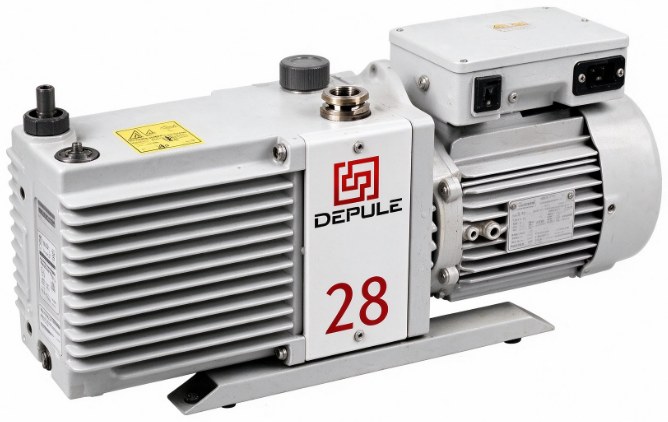
On a freeze dryer the condenser moves the water; the backing pump does the rest. Its job is to remove non-condensable gas and hold the chamber below the ice saturation pressure at product temperature. Three numbers set the sizing boundary: the working pressure decides single-stage or two-stage, the vapour carry-over decides how the pump and cold trap are matched, and the final pull-down decides pipe bore. Work through them and the model range narrows quickly.
1. Working pressure: 0.1 mbar puts single-stage pumps out of range
Sublimation only continues while chamber pressure is below the vapour pressure over ice. That pressure falls fast with temperature: about 0.22 mbar at −35 °C, 0.13 mbar at −40 °C and 0.039 mbar at −50 °C. Primary drying normally runs at 0.1–0.3 mbar.
Check the data sheets against that band. The DPL-V0025A gives 20 m³/h at an ultimate pressure of 0.5 mbar — the 0.1 mbar working point sits below its ultimate, so the pump no longer moves gas and pressure is held only by leakage and desorption. Among single-stage oil-sealed models the DPL-V0040A reaches 0.1 mbar with the gas ballast closed, which is the ultimate itself and leaves no margin.
Two-stage pumps are the right answer here. The DPL-2V18 delivers 17 m³/h at 1×10⁻³ mbar; the DPL-2V28 delivers 27.5 m³/h at the same 1×10⁻³ mbar. The working point sits two orders of magnitude above the ultimate, so the pump runs near its rated speed. One rule of thumb: keep the working pressure at least one order of magnitude above the ultimate pressure.
2. Vapour load: 0.3% carry-over saturates the pump
Start with the volume that water occupies at 0.1 mbar. A 20 kg ice load sublimating over 24 hours averages 0.833 kg/h, or 2.31×10⁻⁴ kg/s. At 0.1 mbar (10 Pa) and 20 °C the specific volume of water vapour, treated as an ideal gas, is v = RT/P = 461.5 × 293 / 10 ≈ 13,500 m³/kg.
That gives 2.31×10⁻⁴ × 13,500 ≈ 3.13 m³/s, or 11,300 m³/h.
A DPL-2V28 is 27.5 m³/h — a factor of 400 apart. Pumping the water straight out of the product is not an option; the cold trap is a necessity, not an accessory.
Downstream of the trap the pump only sees carry-over. Ice at −50 °C has a vapour pressure of 0.039 mbar, so water vapour partial pressure at the pump inlet is held below that, and the theoretical carry-over mass flow is in the milligrams-per-hour range. Reality is worse: traps have direct paths and the surface warms as frost builds. A carry-over of 0.3% is 2.5 g/h, which occupies about 34 m³/h at 0.1 mbar — enough to consume the full 27.5 m³/h of a 2V28.
Pump and cold trap therefore have to be specified together. Gas ballast raises vapour tolerance at the cost of ultimate pressure: the 2V18 and 2V28 reach 1×10⁻³ mbar with the ballast closed and 1.5×10⁻² mbar with it open. Since 1.5×10⁻² mbar stays below the 0.1 mbar working point, running with ballast open during the final stage is acceptable. On the single-stage DPL-V0040A the open-ballast figure is 0.5 mbar, above the working point — it cannot be left open.
3. Final pull-down: the pipe is the bottleneck, not the pump
Estimate pump-down time with t = V/S × ln(P₁/P₂). A 1.2 m³ chamber from atmosphere to 1 mbar takes about 29 min with a 2V18 (17 m³/h), 18 min with a 2V28 (27.5 m³/h) and 6.7 min with a DPL-2V80 (74 m³/h). Roughing is not the problem.
The expensive part is 1 mbar to 0.1 mbar. Below 1 mbar the flow turns transitional and molecular, and pipe conductance should be estimated at its molecular-flow floor, C = 12.1 d³/L (L/s, d and L in cm). For DN25 over 1.5 m, C ≈ 1.26 L/s, so S_eff = 1/(1/7.64 + 1/1.26) ≈ 1.08 L/s. A 1.2 m³ chamber then needs 1,200/1.08 × ln10 ≈ 2,560 s — 43 minutes.
| Inlet line | Conductance | Effective speed | 1→0.1 mbar |
|---|---|---|---|
| DN25 × 1.5 m | 1.26 L/s | 1.08 L/s | 43 min |
| DN40 × 1.5 m | 5.16 L/s | 3.08 L/s | 15 min |
| DN50 × 1.5 m | 10.1 L/s | 4.35 L/s | 11 min |
| DN63 × 1.5 m | 20.2 L/s | 5.54 L/s | 8 min |
The 2V28 inlet is NW25 — the pump is fine, the pipe in front of it is not. Size the final stage on the pipe, not on the pump. The table uses the molecular-flow floor; near 0.1 mbar the flow is transitional and real conductance is higher, so these figures are conservative.
4. Leak rate: it decides whether you hold pressure, not how big the pump is
A 1.2 m³ chamber rising 0.02 mbar over a 30-minute isolation test has an equivalent leak rate of Q = V·ΔP/t = 1,200 × 0.02 / 1,800 ≈ 0.013 mbar·L/s. Removing that at 0.1 mbar needs only S = Q/P = 0.13 L/s, about 1.7% of a 2V28.
Two conclusions follow. Non-condensable load is not the sizing driver — pump-down time is. But a chamber that leaks will not hold vacuum no matter how large the pump, so run the pressure-rise test before considering a bigger model. (The rise figure above is a project acceptance value; the equipment specification governs.)
Summary
| Case | Backing pump | Note |
|---|---|---|
| 1.2 m³ / 20 kg batch | DPL-2V28, 27.5 m³/h, 0.75 kW | DN40 or larger inlet, 15 min final stage |
| 5 m³ / 100 kg batch | DPL-2V80, 74 m³/h, 3 kW | 28 min to 1 mbar, final stage calculated separately |
| Multiple chambers | 2V80 with LC250 roots booster, or a packaged unit | A booster only helps once the backing pump is right |
Other constraints on food and pharmaceutical freeze-drying lines — clean exhaust, washdown, continuous duty — are covered under /industries/food-pharma/; pump-down time can be back-calculated with /calculator/. For 60 Hz areas, note that some models are not suitable for 60 Hz supply and the configuration must be confirmed with the factory before ordering. More questions are answered in /faq/.