
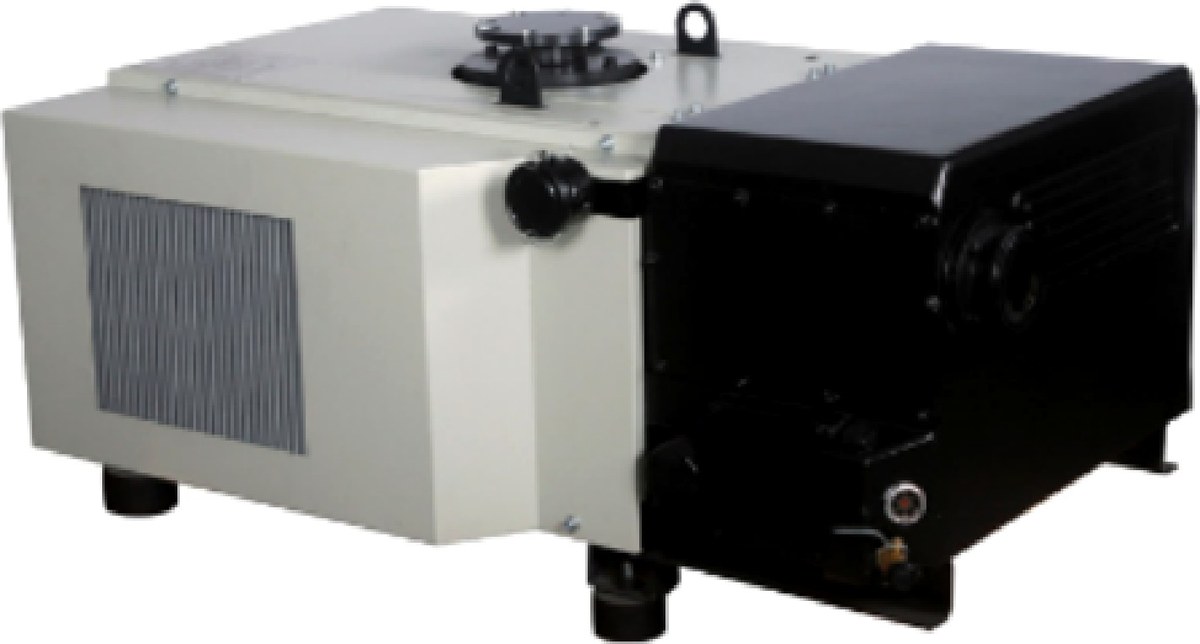
| Item | V0155 | V0160 |
|---|---|---|
| Rated pumping speed (50/60 Hz) | 150 / 175 m³/h | 160 / 190 m³/h |
| Ultimate vacuum (gas ballast closed) | 0.3 mbar | 0.1 mbar |
| Ultimate vacuum (gas ballast open) | 0.5 mbar | — |
| Motor power | 4.0 kW | 4 kW |
| Voltage | 3-phase 220/240 V, 380/415 V | 3-phase 220/240 V, 380/415 V |
| Inlet / exhaust | G2" / G2" | G2" / G2" |
| Noise (50/60 Hz) | 70 dB | 70 / 72 dB |
| Oil charge | 4 L | 5 – 8.5 L (series range) |
| Weight | 108 kg | 120 kg |
The speed difference is 6.7%. Power is identical, the flange is identical, the footprint is in the same class. So “take the bigger one to be safe” is not a working strategy here — if the extra capacity does not land on ultimate vacuum, you have bought a speed difference you cannot measure in the field.
2. Run the arithmetic: what ten cubes buy in time
Take a chamber with 2 m³ of free volume, pumped from atmosphere (1013 mbar) down to 10 mbar. Using the constant-speed approximation for the volume phase:
t = (V / S) × ln(P₁ / P₂)
- V0155: S = 150 m³/h = 2.5 m³/min, t = (2 / 2.5) × ln(1013 / 10) = 0.8 × 4.618 ≈ 3.69 min
- V0160: S = 160 m³/h = 2.67 m³/min, t = (2 / 2.67) × 4.618 ≈ 3.46 min
The difference is 0.23 minutes — 14 seconds. On the same piping and the same chamber, that is easily swallowed by flange leak rate, wall outgassing and valve changeover time.
So if the process never goes below 10 mbar, the extra ten cubes do not justify the extra 12 kg and the extra 1 – 4.5 L of oil.
3. The gap opens up near the ultimate pressure
Push the target down to 0.5 mbar and the picture changes. In this range the ultimate pressure has to enter the calculation, because pumping speed falls away sharply as you approach it:
t = (V / S) × ln[(P₁ − Pu) / (P₂ − Pu)], where Pu is the ultimate pressure
- V0155 (Pu = 0.3): t = 0.8 × ln[(10 − 0.3) / (0.5 − 0.3)] = 0.8 × 3.881 ≈ 3.11 min
- V0160 (Pu = 0.1): t = 0.75 × ln[(10 − 0.1) / (0.5 − 0.1)] = 0.75 × 3.209 ≈ 2.41 min
Same stretch of the curve, 0.70 minutes apart — 42 seconds, 29% slower. Added up: 6.80 min for the V0155 against 5.87 min for the V0160.
The formula is a simplification. Real speed drops faster than constant-speed maths suggests below 10 mbar, so a real machine will take longer than calculated. The trend holds: the closer you get to ultimate, the more the ultimate-pressure difference matters and the less the speed difference matters.
Take it one step further. If the process needs 0.2 mbar, the V0155 with its 0.3 mbar floor is not slow — it simply never gets there. No amount of calculation helps.
4. When 0.3 mbar is enough
Not every process needs 0.1 mbar. In these cases the V0155 is the cheaper correct answer:
- Vacuum holding and lifting: working point around 40 – 70 mbar, far from ultimate
- Vacuum packing, impregnation, dipping: working point often 5 – 50 mbar, what counts is speed and recovery
- Vacuum drying and degassing: wet gas is handled with the gas ballast, and with the ballast open the ultimate is 0.5 mbar anyway
- Behind a Roots blower whose working range is 1 – 100 mbar to begin with
The V0160 becomes mandatory in these situations:
- Backing a coating or heat-treatment system where the high-vacuum pump may only be started below 0.1 mbar
- Vacuum distillation, where the end pressure sits at 0.1 – 0.2 mbar
- A process that must hold below 0.3 mbar without gas ballast
- Long running close to ultimate, where a higher floor means poor volumetric efficiency, higher oil temperature and faster oil consumption
5. Do not read the table from top to bottom
One detail in this series is easy to miss: ultimate vacuum does not improve monotonically with pumping speed.
| Model | Speed (50 Hz) | Ultimate (ballast closed) |
|---|---|---|
| V0160 | 160 m³/h | 0.1 mbar |
| V0202 | 200 m³/h | 0.1 mbar |
| V0250 | 250 m³/h | 0.5 mbar |
| V0302 | 300 m³/h | 0.5 mbar |
| V300B | 280 m³/h | 0.08 mbar |
The V0302 moves almost twice the volume of a V0160 and its ultimate is four times worse. The two figures come from different design trade-offs: speed follows bore and rotational speed, ultimate pressure follows clearances, oil circuit and exhaust design, and the process segment the model was built for.
The right order is: fix the working pressure and whether gas ballast will be used, filter for models that reach that pressure, then choose among the survivors by speed and cycle time. Start from the speed column instead and you can easily buy a pump that pumps fast but will not pull down.
6. 60 Hz sites and installation
Both pumps gain speed at 60 Hz: the V0155 goes to 175 m³/h and the V0160 to 190 m³/h, so the gap widens from ten cubes to fifteen. For 60 Hz sites, size from the 60 Hz column — and note that some models are not suitable for 60 Hz areas, so the exact model and configuration must be confirmed before ordering. Noise moves too: 70 dB for the V0155, 72 dB at 60 Hz for the V0160, so treat the higher figure as the room-acoustic target.
On installation, 108 kg and 120 kg both sit in the range that can be set down without lifting gear, but size the anti-vibration pads and anchor bolts for the whole machine, not the pump body. Fill oil to each unit’s own sight glass: 4 L on the V0155, and within the 5 – 8.5 L range on the V0160 depending on the specific model.
7. The choice in one line
- Working point above 1 mbar and no need to pull below 0.3 mbar → V0155, less weight, less oil, a simpler machine
- Working point anywhere between 0.1 and 0.3 mbar, or explicitly below 0.3 mbar → V0160; a 0.3 mbar pump has no margin here and physically cannot reach it
- Frequent gas ballast for water vapour or solvents while also needing below 0.3 mbar → reassess both; the V0155 with ballast open has a 0.5 mbar ultimate, and no setting will change that
Two adjacent boxes on a selection sheet are often not “about the same, take the bigger one” but “one is enough, the other is not”. Establish where the process actually stops on the pressure axis first, then look at pumping speed — reverse the order and the wrong pump gets installed.
Related reading
- Is 0.1 mbar enough for coating backing pumps
- When to open the gas ballast, and for how long
- 2V80 versus V0100: is 4×10⁻⁴ mbar worth paying for?
- V0025A - V0100 Single-stage Oil-sealed Rotary Vane Vacuum Pump
- V0155 Single-stage Oil-sealed Rotary Vane Vacuum Pump
- V0630B Single-stage Oil-sealed Rotary Vane Vacuum Pump