
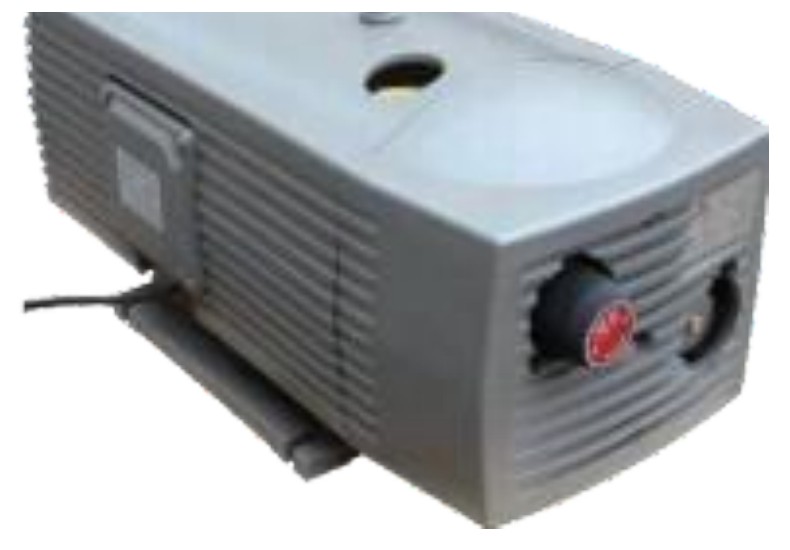
Put the two datasheets side by side and the double-stage looks like the wrong buy: both motors are 3 kW, the single-stage V0100 pulls 100 m³/h against 74 m³/h for the 2V80, . Less speed for the same power — why choose it?
The answer sits on a different line of the sheet. Ultimate pressure is 0.1 mbar on the V0100 and 4×10⁻⁴ mbar on the 2V80. That is not a margin, it is two orders of magnitude, and it decides whether a process can be run at all.
Where the structure differs. A single-stage pump has one working chamber: intake, compression, exhaust, done. Its ultimate pressure is limited by the pressure ratio the last stage can build, together with valve losses, clearance leakage and the vapour pressure of the oil; 0.1 mbar is what a conventional single-stage design delivers. A double-stage pump puts two chambers in series — the gas is compressed to an intermediate pressure, then compressed again and discharged. Each stage carries a smaller ratio, so leakage and backflow weigh proportionally less, and the end pressure drops far lower: 4×10⁻⁴ mbar on the 2V80, 5×10⁻⁴ mbar on the 2V275. The cost is visible in the numbers: the same 3 kW now drives two stages and an interstage passage, which is why the 50 Hz speed is 74 m³/h rather than 100.
| Item | 2V80 (two-stage) | V0100 (single-stage) |
|---|---|---|
| Speed, 50/60 Hz | 74 / 90 m³/h | 100 / 110 m³/h |
| Ultimate, ballast closed | 4×10⁻⁴ mbar | 0.1 mbar |
| Ultimate, ballast open | 5×10⁻³ mbar | 0.5 mbar |
| Motor | 3 kW | 3.0 kW |
| Inlet / exhaust | ISO40(KF40) / NW25(KF25) | G1 1/4" / G1 1/4" |
| Noise | 70 dB | see nameplate |
| Oil charge | 5 L | 2 L |
| Weight | 125 kg | 75 kg |
The row worth reading twice is the ballast line. With the ballast open the single-stage falls to 0.5 mbar while the two-stage still holds 5×10⁻³ mbar. On wet loads, solvents and degassing, where the ballast runs for hours, that gap matters more than the closed-ballast figure.
A worked example: 1.2 m³ to 5×10⁻² mbar. Take a heat-treatment furnace with a net chamber volume of 1.2 m³, a process requirement of 5×10⁻² mbar, and a 20-minute cycle. Use the constant-speed estimate for rough pumping:
t = (V / S) × ln(P₁ / P₂)
with V the chamber volume, S the nominal speed in m³/s, P₁ atmospheric at 1013 mbar and P₂ the target.
2V80 at 74 m³/h = 0.0206 m³/s: the time constant V/S is 1.2 / 0.0206 ≈ 58.4 s, ln(1013 / 0.05) ≈ 9.92, so t ≈ 58.4 × 9.92 ≈ 579 s, about 9.6 minutes.
The V0100 gives 0.0278 m³/s, a time constant of 43.2 s and about 7.1 minutes — arithmetically true, but only if the pump can hold 5×10⁻² mbar. Its ultimate is 0.1 mbar, so the second half of that calculation has no meaning.
Now the margin. The estimate assumes constant speed, a leak-free chamber and no outgassing; none of the three holds in a real furnace. A factor of about 1.5 is a reasonable allowance: the 2V80 lands at 14–15 minutes, still inside the 20-minute cycle. If the chamber is insulated, the fixture area is large or the load itself carries gas, that factor grows and the margin disappears.
At 4 m³ the 2V80 runs out of time constant; move to the 2V275 (255 m³/h, 7.5 kW, 5×10⁻⁴ mbar): time constant 56.5 s, ideal 9.3 minutes, about 14 minutes with the same 1.5 allowance.
When the two-stage is worth it. Target pressure below 0.1 mbar — a hard gate, the single-stage cannot reach it. Long ballast operation on wet or solvent-laden loads. Sensitivity to oil backstreaming: with two stages each carries a smaller ratio, the gradient across the interstage and exhaust side is gentler and the return path at shutdown is shorter, which for clean chambers matters more than the ultimate figure. And when a Roots stage is added later, the backing pump’s ultimate sets the floor for the whole train — a backing pump stopping at 0.1 mbar cannot be rescued by a bigger booster.
When it is not. Holding, handling, packaging and pick-and-place work in the tens to hundreds of mbar; dusty lines with short service intervals, where the two-stage teardown and the 5 L oil charge cost more time; and sites short of space or floor capacity, since the 2V80 weighs 125 kg against 75 kg.
Three things that get missed in the installation. The inlet is ISO40(KF40) on the 2V80 and G1 1/4" on the V0100 — size the piping and valves for the actual port instead of forcing a reducer, whose pressure loss is a real loss of pumping speed in rough pumping. The exhaust is NW25(KF25), much smaller than the inlet; a long or undersized exhaust line raises back pressure and costs ultimate pressure. And for 60 Hz destinations, confirm before ordering: the 2V80 runs 90 m³/h at 60 Hz, but some models are not suited to 60 Hz areas and must be checked with the factory first.
So the question is not which sheet has the bigger number, but which side of 0.1 mbar the process sits on. Above it, the V0100’s 100 m³/h is enough. Below it — or with the ballast open for hours on wet material — the 2V80’s 74 m³/h is the pump that works, and no amount of extra speed buys pressure.
Related reading
- Is 0.1 mbar enough for coating backing pumps
- When to open the gas ballast, and for how long
- Where oil emulsification comes from: three sources and how to judge an oil change
- V0025A - V0100 Single-stage Oil-sealed Rotary Vane Vacuum Pump
- V0155 Single-stage Oil-sealed Rotary Vane Vacuum Pump
- V0630B Single-stage Oil-sealed Rotary Vane Vacuum Pump