
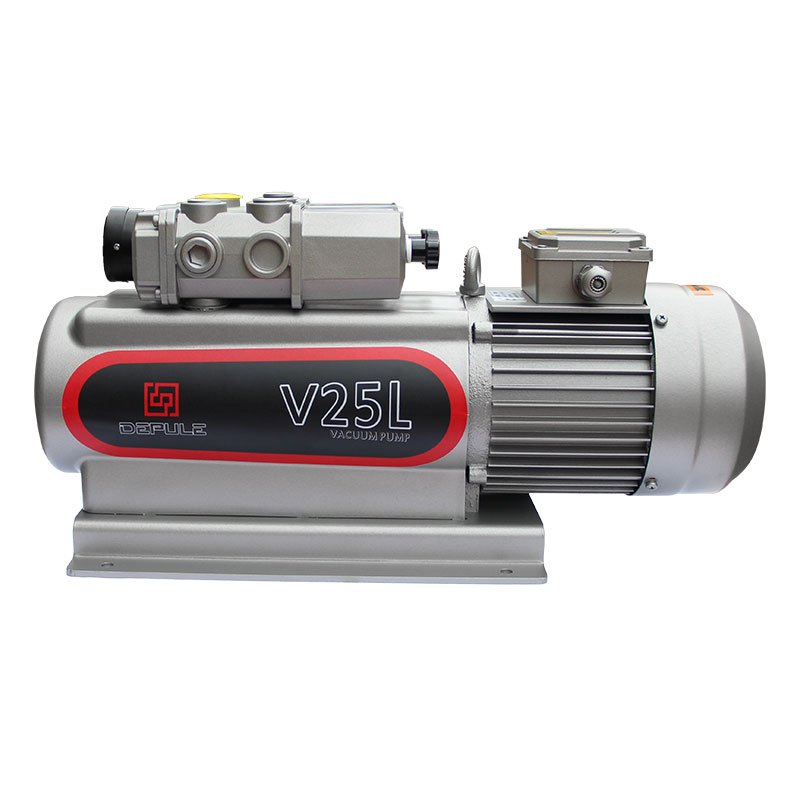
The 90 kPa in the table is gauge vacuum relative to atmosphere. Against a standard 101.3 kPa atmosphere, that puts the pump inlet at roughly 11 kPa absolute. The product page also lists a working vacuum of 85 kPa, meaning the inlet sits near 16 kPa absolute in continuous duty. The 5 kPa gap is line loss and cup leakage; the nameplate figure is only reachable with the inlet blanked off.
The force on a suction cup depends on differential pressure and area alone:
F = ΔP × A
A φ50 cup has 19.63 cm² of area. At 60 kPa vacuum the differential is 60 kPa, so F = 0.001963 m² × 60000 Pa ≈ 118 N, about 12 kgf. Theory aside, here is the same calculation across common sizes:
| Cup diameter | Effective area | At 60 kPa vacuum | At 85 kPa vacuum |
|---|---|---|---|
| φ20 | 3.14 cm² | 18.8 N / 1.9 kgf | 26.7 N / 2.7 kgf |
| φ30 | 7.07 cm² | 42.4 N / 4.3 kgf | 60.1 N / 6.1 kgf |
| φ40 | 12.57 cm² | 75.4 N / 7.7 kgf | 106.8 N / 10.9 kgf |
| φ50 | 19.63 cm² | 117.8 N / 12.0 kgf | 166.9 N / 17.0 kgf |
| φ80 | 50.27 cm² | 301.6 N / 30.7 kgf | 427.3 N / 43.6 kgf |
| φ100 | 78.54 cm² | 471.2 N / 48.0 kgf | 667.6 N / 68.1 kgf |
Run the same table at 85 kPa and every figure grows by a factor of 1.42. Double the differential and the force doubles; motor power has little to do with it.
Apply a safety factor
A cup is not a rigid body. Workpiece surfaces carry oil film, texture and distortion, and the sealing lip never conforms perfectly. The usual practice is to size by direction of lift: horizontal lift with no acceleration takes a factor of 2; side lift, acceleration, or a rough surface takes 3 or more.
Example: a 2 kg aluminium plate on four φ30 cups at 60 kPa. Each cup gives 4.3 kgf, 17.2 kgf total, 8.6 kgf allowed at a factor of 2 — better than four times the margin. Switch the same part to two φ20 cups and the total drops to 3.8 kgf, 1.9 kgf allowed, below the weight of the part. That is where intermittent dropped parts come from.
Speed decides how fast the part is held, not whether it can be
Holding force is a pressure question; response time is a displacement question. The V8 is rated 6.8 m³/h at 50 Hz, or 1.89 L/s. With a 20 L buffer tank at the machine, pulling down from atmosphere to 40 kPa absolute:
t = V / S × ln(P₁/P₂) = 20 / 1.89 × ln(101.3 / 40) ≈ 9.8 s
That 9.8 s is pumping only, before any leakage around the part. The same duty on a V16 (16 m³/h, 4.44 L/s) with a 50 L tank takes about 10.5 s. If the cycle demands vacuum within 3 s, shrinking the tank usually beats upsizing the pump: cut the tank from 20 L to 5 L and the V8 pulls down in about 2.5 s.
Holding pressure is set by leakage, not by ultimate vacuum
Porous parts — cardboard, foam, fabric, sintered components — plus hose joints and rotary unions all leak. The V8 nominally moves 133 L/min. If the system leaks 20 L/min at a 60 kPa differential, 113 L/min remains, and the set point still holds; the pump simply runs flat out, with temperature and noise climbing. Once leakage approaches nominal displacement, the set point cannot be held, and the symptom is a cup that drops parts now and then.
When 90 kPa genuinely falls short
Three cases. First, chamber evacuation that needs below 10 kPa absolute — vacuum packaging, impregnation, de-aeration — which a 90 kPa pump cannot reach. Second, backing duty for coating or heat treatment at the 0.1 mbar level, which calls for an oil-sealed rotary vane pump: the V0025A reaches 0.5 mbar, the V0040A through V0100 reach 0.1 mbar. Third, long piping runs with many elbows eating 10 kPa or more; check the line size before changing the pump.
Three questions before selecting
- What differential pressure does the lift need? Work back from part weight, cup count and safety factor, then decide whether to calculate at 60 kPa or 85 kPa.
- How many seconds until vacuum is established? Use t = V/S·ln(P₁/P₂), with V covering cups, hoses and tank combined — not the tank alone.
- How much leakage? Measure it on porous parts; allow 20 to 30 L/min on ordinary sheet-metal work.
Answer those three and the choice among the V3 (3.4 m³/h), V8 (6.8 m³/h), V10 (10 m³/h) and V16 (16 m³/h) mostly settles itself. If the first answer is “below 10 kPa absolute”, go straight to an oil-sealed pump.
Some models are not suitable for 60 Hz areas, and displacement changes with speed (V8: 6.8/8.6 m³/h, V10: 10/12 m³/h, V16: 16/18.2 m³/h at 50/60 Hz). Please confirm voltage and frequency with us before ordering for overseas projects.
Related reading
- Where oil-free rotary vane vacuum pumps fit
- Routine care for oil-free rotary vane vacuum pumps
- Inside a single-stage oil-free rotary vane pump
- V15/25/40H Single-stage Oil-free Rotary Vane Vacuum Pump
- V25/40 Single-stage Oil-free Rotary Vane Vacuum Pump (single suction)
- V10 Single-stage Oil-free Rotary Vane Vacuum Pump