
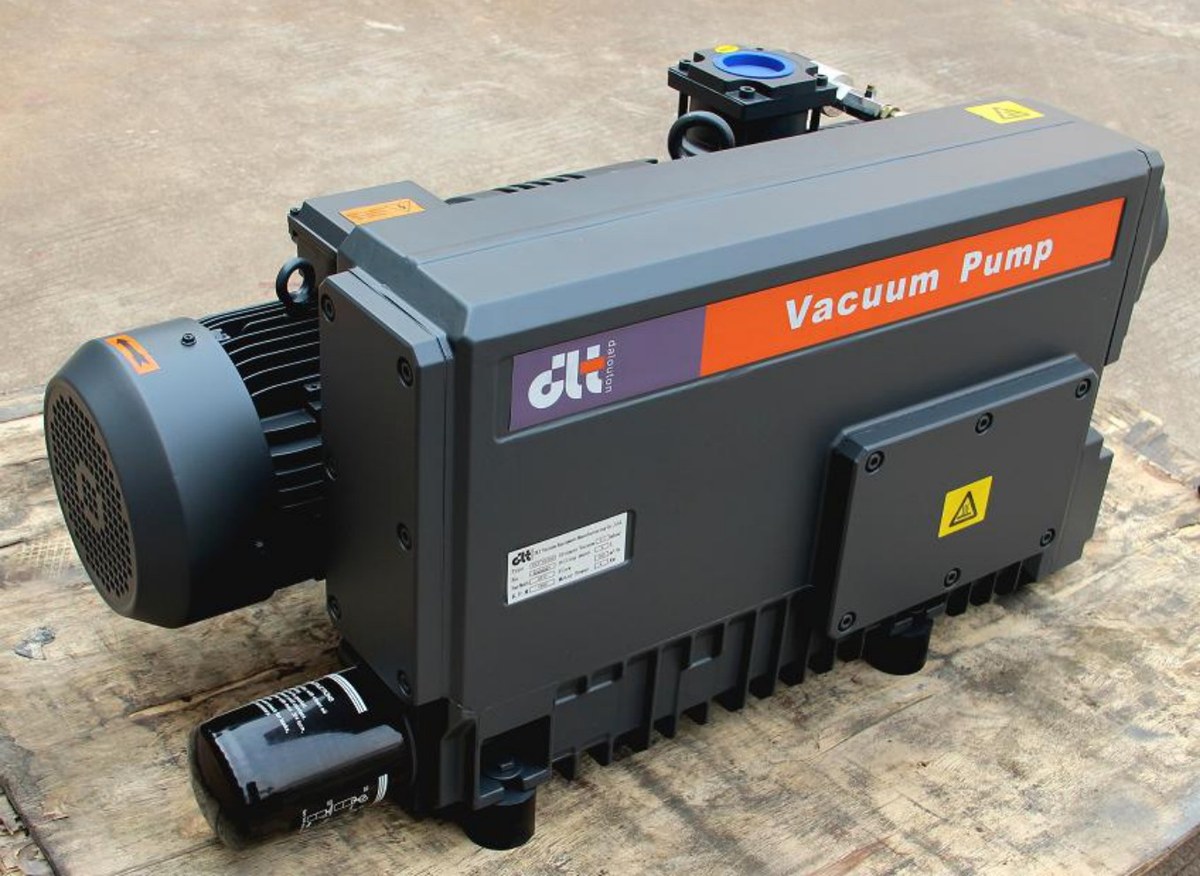
A milky sight glass, or a level higher than last time you looked — the most common problem on oil-sealed rotary vane pumps. Emulsification itself is simple; what follows is not, because it drags ultimate pressure down and eventually scores the vanes.
What it is. Water gets into the oil and the vanes beat it into fine droplets dispersed through the oil. Past a certain water content the lubricity drops, the oil film stops carrying load, and dry contact begins between vane and casing. Emulsified oil looks white or grey, loses clarity, separates on standing and changes viscosity. On filter paper the water spreads a distinct ring.
Source one: the process gas carries water vapour. Cooking, drying, evacuation after washing, degassing wet material — all put high water-vapour partial pressure into the pump. During compression that vapour passes saturation and condenses.
Source two: solvents. Printing, coating and degreasing carry solvents into the chamber; some leaves with the exhaust, some dissolves into the oil. Solvents do not necessarily whiten the oil, but they thin it, lower its flash point, reduce its load capacity and attack seals.
Source three: backflow and condensation at shutdown. After the pump stops, temperature falls, vapour in the piping and chamber condenses and runs back through the inlet into the oil. Common in humid seasons and in workshops with wide day-to-night swings, especially where the gas ballast was not run before shutdown.
The gas ballast is the right answer for water vapour. It admits a little air during compression, pushing the condensable gas below its saturation point so it leaves as vapour. The cost is ultimate pressure: on V0040A, V0063 and V0100, 0.1 mbar becomes 0.5 mbar with the ballast open; V0630B offers three settings — 0.1 mbar closed, 0.8 mbar on one stage, 2 mbar on both.
So the conflict is explicit. A process needing 0.1 mbar cannot run with the ballast open all day; a process dominated by water vapour will keep emulsifying the oil. That gap is closed with a pre-condenser, a liquid separator or a different pump type — frequent oil changes do not fix it.
Changing out emulsified oil. Run 20–30 minutes with the ballast open to drive moisture out; stop and drain, watching for separation and sediment; flush with a little fresh oil while turning the shaft, then drain; fill to the middle of the sight glass and check after running; sample again a week later — if it whitens again, the source is still there.
Avoiding it at the selection stage. Quantify the water-vapour share and specify a separator or pre-condenser when needed; choose solvent-resistant seals and confirm oil compatibility; write “run 5 minutes with the ballast open before shutdown” into the operating procedure for humid sites; and prefer continuous running to frequent stops, each of which is another chance to condense.