
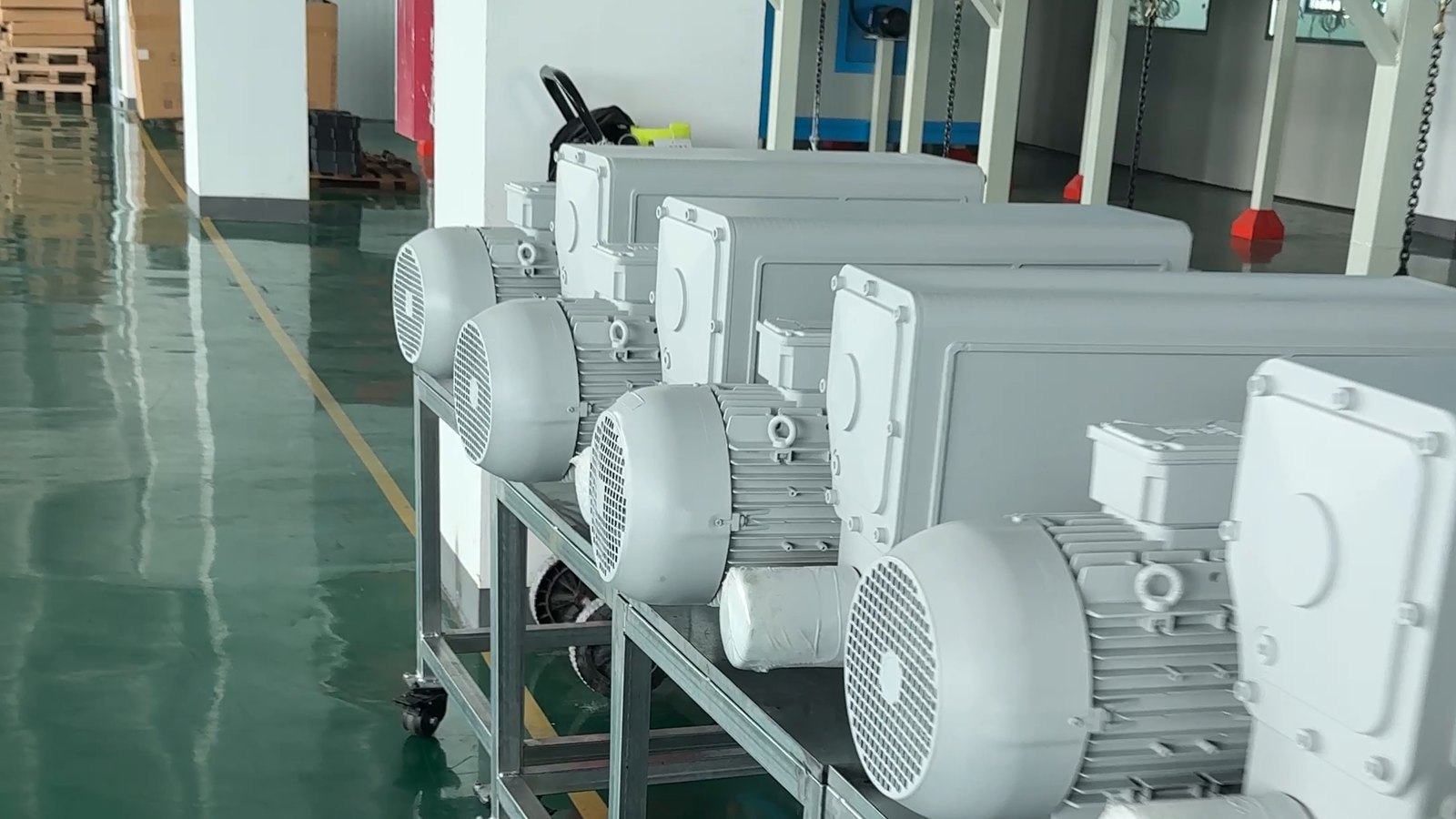
A central vacuum system gathers the small pumps scattered across the shop into one plant room and distributes vacuum to every point through piping, leaving only a valve and a quick coupling at the machine.
Why centralise: individual pumps are sized for the peak of one machine and spend most of their time lightly loaded; a central system sizes the pumps on total demand, shaves peaks with a receiver, and manages run count and rotation from the control panel. Power consumption and the number of service points both fall, and the heat and noise move to one room.
CNC machining and automatic drainage: coolant and cutting water get drawn into the pipework and are the most common problem in a central system.
Design sequence: count the pick-up points, the capacity each needs and the diversity factor, then calculate average and peak flow; size the pipe from allowable pressure loss rather than a rule of thumb; choose the number of pumps and receiver volume; finally fix the control scheme (pressure switch, constant pressure VFD or pump rotation).
Piping notes: step the pipe up from pump to end point, use long-radius bends, and put a valve at each branch so sections can be isolated for service; drain the low points; fit flexible connections and check valves at each pump so one can be serviced while the others keep running.
Systems are built to site conditions; a quotation needs the shop layout, the list of pick-up points and the required process vacuum.
Specifications
| Pump options | Single-stage oil-sealed · Roots booster |
|---|---|
| Typical points | CNC holding, robots, packaging lines, coating chambers, multi-station fixtures |
| Control | Pressure band start/stop / constant pressure VFD / multi-pump interlock and rotation |
| Scope | Receiver, moisture separator, fine filter, automatic drain, piping and end valves |