
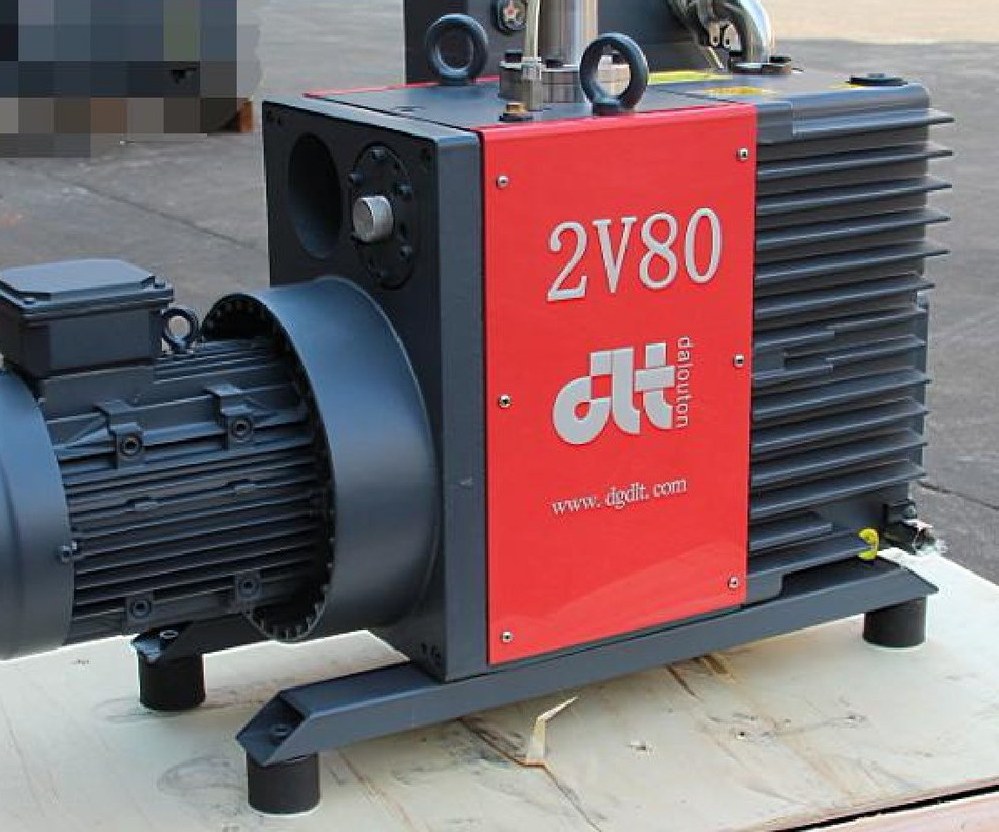
The two-stage layout puts two pump chambers in series: gas from the front stage is compressed once more by the rear stage, which takes ultimate vacuum from the 0.5 mbar level of a single stage down to the 10⁻⁴ mbar level. The 2V80 reaches 4×10⁻⁴ mbar with the ballast closed, the 2V275 reaches 5×10⁻⁴ mbar; both sit at 5×10⁻³ mbar with it open.
The 2V80 moves 74 m³/h at 50 Hz on 3 kW, with ISO40/KF40 inlet and NW25/KF25 outlet, 125 kg. The 2V275 moves 255 m³/h on 7.5 kW, ISO63 inlet and ISO40 outlet, 225 kg, and needs a cooling water circuit: 3 bar maximum pressure, 120 L/h minimum flow suggested at 20 °C.
The 2V275 needs cooling water, which is the main installation difference from the 2V80. Sites without a water supply need a chiller or a tank.
Typical uses: vacuum impregnation, vacuum coating, microelectronics and optoelectronics, packaging and test, plasma cleaning, vacuum and freeze drying as a backing pump. These processes need below 10⁻³ mbar, which a single-stage pump cannot hold.
Open the gas ballast when pumping vapour or condensable gas; ultimate vacuum drops to the 10⁻³ mbar level. Where the process needs the ultimate figure, close the ballast and fit a cold trap on the inlet.
Specifications
| Rated capacity 50/60 Hz (2V80 / 2V275) | 74/90 · 255/306 m³/h |
|---|---|
| Ultimate vacuum (ballast closed) | 4×10⁻⁴ / 5×10⁻⁴ mbar |
| Ultimate vacuum (ballast open) | 5×10⁻³ mbar |
| Motor | 3 / 7.5 kW |
| Supply | Three phase 220/240 V, 380/415 V |
| Inlet / outlet (2V80) | ISO40 (KF40) / NW25 (KF25) |
| Inlet / outlet (2V275) | ISO63 / ISO40 |
| Noise | 70 dB |
| Oil capacity | 5 / 18 L |
| Weight | 125 / 225 kg |